Can I Use Any Power Supply with My Pedal Board?
Wondering if you can use any power supply with your pedal board? Learn the risks, gold rules of pedal power, and why isolated power supplies are key.
Music Gear Specialist Review Desk
Gear Research & Analysis
ℹ️ Affiliate Disclosure: Music Gear Specialist earns from qualifying purchases through Amazon and other partner links. This doesn't affect our recommendations—we only suggest gear we'd use ourselves.
If you’ve recently bought a few new effects pedals, you might be looking at the tangle of power adapters in your home and wondering: can i use any power supply with my pedal board?
The short answer is a definitive no.
Using the wrong power supply on your pedalboard can lead to three outcomes, and only one of them is good. At best, your pedals simply won’t turn on. In the middle ground, your board will sound like a swarm of angry bees due to electrical hum. At worst, you will smell burning plastic as you permanently fry the internal circuit of a $200 boutique pedal.
To build a reliable, noise-free pedalboard, you need to understand the basic physics of pedal power: voltage, current draw, polarity, and isolation.
Rule 1: Voltage Must Match Exactly (9V vs. 12V vs. 18V)
Voltage is the electrical pressure pushed into your pedal. You must match the pedal’s required voltage exactly.
Most guitar pedals on the market run on 9V DC (Direct Current). However, there are exceptions:
- 9V DC: The industry standard. Used by Boss, MXR, Electro-Harmonix, TC Electronic, and almost all standard pedals.
- 12V DC: Commonly required by some larger digital units, tube-driven preamp pedals, and certain older effects.
- 18V DC: Used by some high-headroom overdrive, distortion, and boost pedals (such as some MXR or boutique drives) to provide cleaner sound before clipping.
What happens if you get voltage wrong?
- Too Low (Under-voltage): If you plug a 9V power supply into an 18V pedal, the pedal will either refuse to turn on, or it will sound weak, thin, and distorted (though it generally won’t damage the pedal).
- Too High (Over-voltage): If you plug an 18V power supply into a standard 9V pedal, you will likely destroy the pedal instantly. Most pedals have small capacitors and voltage regulators that cannot handle the excess pressure. They will overheat, burn, and die.
[!IMPORTANT] DC vs. AC Power: Make sure you don’t confuse Direct Current (DC) with Alternating Current (AC). A tiny fraction of vintage or specialized pedals (like older Digitech Whammy pedals) require AC power. Plugging a DC adapter into an AC pedal, or vice-versa, will result in immediate damage.
Rule 2: Polarity Must Be Center-Negative
Polarity refers to the direction electrical current flows through the barrel connector plug.
The standard plug for guitar pedals is a 2.1mm barrel jack. This connector has two parts: the center pin and the outer sleeve.
- Center-Negative (Standard): The center pin is negative (-), and the outer sleeve is positive (+). This is the standard configuration for 95% of guitar pedals.
- Center-Positive: The center pin is positive (+), and the outer sleeve is negative (-). This is the standard for most consumer electronics (like routers, keyboards, and household appliances).
Look for the polarity symbol on the pedal or its adapter:
Center-Negative (Standard):
( - ) ----(o---- ( + )
Center-Positive:
( - ) ----o)---- ( + )The Danger of Reversing Polarity
If you plug a standard center-positive household adapter into a center-negative guitar pedal, the electricity flows backward. Unless the pedal has a built-in protection diode (which many do not, or the diode fails under stress), you will fry the pedal’s integrated circuits (ICs) instantly. Always verify the polarity symbol before plugging in an adapter.
Rule 3: Current Draw (mA) Must Meet or Exceed Requirements
Current is the amount of electricity a pedal draws, measured in milliamps (mA).
Unlike voltage, which must match exactly, current is a pull system. Your power supply must provide at least the amount of current your pedals demand. It is perfectly safe to use a power supply that offers more mA than your pedal needs—the pedal will only draw what it requires.
Digital vs. Analog Current Draw
Pedals vary wildly in how much current they draw:
| Pedal Type | Typical Draw (mA) | Example Pedals |
|---|---|---|
| Analog Drive/Fuzz | 5mA – 20mA | Ibanez TS9 Tube Screamer, Boss DS-1 |
| Analog Modulation | 20mA – 60mA | MXR Phase 90, Boss CE-2W |
| Digital Delay/Reverb | 100mA – 300mA | Strymon Flint, Boss DD-8 |
| Multi-Effects / Modelers | 300mA – 1000mA+ | Line 6 HX Stomp, Boss GT-1000CORE |
If you plug a digital pedal that draws 250mA into a power supply output rated for only 100mA, the pedal will fail to boot, freeze, or cut out during play.
Daisy Chains vs. Isolated Power Supplies
Once you ensure your voltage, polarity, and mA match, you have to choose how to distribute power to your pedals.
1. Daisy Chains (Non-Isolated Power)
A daisy chain connects one power adapter (like a Truetone 1 Spot) to multiple pedals using a single daisy-chain cable. In this setup, all pedals share the same electrical ground.
- Pros: Very inexpensive ($15–$30); compact and easy to carry.
- Cons: Extremely prone to ground loop noise. Because all pedals share the same ground line, high-frequency digital clock noise from digital delay or reverb pedals will leak into the ground and be amplified by your high-gain overdrive or fuzz pedals. This produces a constant high-pitched hum, buzz, or digital whine.
When to use a daisy chain: If you only run 3 or 4 simple analog pedals (e.g., tuner, overdrive, compressor, fuzz) that have very low current draws and no digital clocks.
Truetone 1 Spot 9V DC Adapter (Daisy Chain)
2. Isolated Power Supplies (The Professional Standard)
An isolated power supply (like units from Strymon or Voodoo Lab) uses a dedicated transformer (or advanced opto-isolated switching circuits) for each individual output. Each output is electrically independent.
- Pros: Dead silent operation. There is zero electrical path for digital noise to bleed into analog pedals, eliminating ground loops entirely. They also feature robust short-circuit and surge protection for each output.
- Cons: Expensive ($100–$300); heavier and bulkier.
When to use an isolated supply: If your board has 5 or more pedals, if you use a mix of digital and analog pedals, or if you plan to play gigs or record in a studio where noise is unacceptable.
Top Recommended Isolated Power Supplies
If you are ready to upgrade your pedalboard’s power source to prevent damage and eliminate hum, here are the top-tier isolated power supplies we recommend:
1. Voodoo Lab Pedal Power 2 Plus
For over a decade, this has been the touring industry standard. It features eight fully isolated, filtered outputs (each 9V DC, with options for 12V and sag controls to simulate a dying battery for fuzz pedals). It is rugged, reliable, and fits perfectly under most Pedaltrain pedalboards.
Voodoo Lab Pedal Power 2 Plus
2. Strymon Zuma
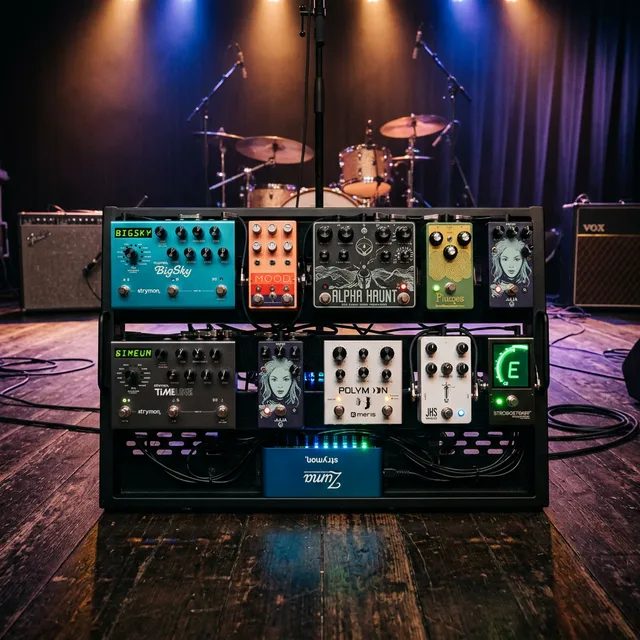
If you run modern, power-hungry digital pedals (like Strymon, Eventide, or Line 6 modelers), the Strymon Zuma is the ultimate power supply. It offers nine outputs, each capable of delivering a massive 500mA at 9V DC. Two of these outputs can be switched to 12V or 18V, and the unit is dual-stage isolated to guarantee dead-silent performance.
Strymon Zuma Isolated Power Supply
3. Strymon Ojai
For smaller pedalboards or as an expansion to the Zuma, the Strymon Ojai is a ultra-compact, high-current isolated power supply with five outputs (each supplying 500mA at 9V DC). Its slim profile makes it perfect for mounting under flat or low-profile boards.
Strymon Ojai Compact Power Supply
Summary: A Checklist for Safe Pedal Power
Before you plug any power cable into a guitar pedal, run through this simple checklist:
- Check the pedal’s manual or label to find its required voltage (e.g., 9V DC), polarity (usually center-negative), and current draw (e.g., 150mA).
- Verify the power supply output matches the voltage exactly (never run 12V or 18V into a 9V-only pedal).
- Confirm the polarity is center-negative (look for the symbol indicating the minus sign pointing to the center dot).
- Make sure the power supply output provides at least as many mA as the pedal draws (higher is fine; lower is not).
- Use an isolated power supply if you hear ground hum or mix digital and analog pedals.
Investing in a high-quality, isolated power supply might not be as exciting as buying a new overdrive or delay pedal, but it is the single best way to protect your gear and ensure your tone is as clean and professional as possible.
Related Reading
- Guitar Pedal Power Supply Compatibility Guide
- Best Pedalboards and Power Supplies
- How to Reduce Pedalboard Noise
- Pedalboard Setup Guide: Signal Chain Order Explained
- Best Multi-Effects Pedals for Guitarists
- Eliminate Ground Loop Hum and Buzz in Your Studio
- Guitar Pedals Explained: A Beginner’s Guide

Music Gear Specialist Review Desk
Research-based reviewsResearch-based reviews · Manufacturer specs · Verified owner feedback
We review guitars, amps, pedals, and recording gear the honest way: spec sheets, published measurements, and the collected experience of working musicians and verified owners.