How to Choose a Guitar Stand: Secure Support and Safe Storage
Select the perfect stand or wall hanger for your guitar. Learn about nitrocellulose safety, A-frames, multi-guitar racks, and Hercules mounts in 2026.
Music Gear Specialist Review Desk
Gear Research & Analysis
ℹ️ Affiliate Disclosure: Music Gear Specialist earns from qualifying purchases through Amazon and other partner links. This doesn't affect our recommendations—we only suggest gear we'd use ourselves.
Storing your guitar properly prevents accidental drops and finish damage. A good stand or wall hanger keeps your instrument secure and ready to play at any moment. This guide explains the differences between stand styles, wall hangers, and how to protect your guitar’s finish in 2026.
Executive Summary
| Stand Type | Best For | Finish Safety | Pros | Cons |
|---|---|---|---|---|
| A-Frame | Acoustic guitars & tight spaces | Varies by brand | Compact, fits in gig bags | Easy to knock over backward |
| Tubular Tripod | Budget-conscious players | Often unsafe for nitro | Cheap, height-adjustable | Flimsy neck straps, bulky |
| Hercules Hanging | Premium guitars & maximum safety | 100% nitro-safe | Auto-grip lock, very stable | Expensive, large floor footprint |
| Wall Hangers | Space saving & keeping away from pets | Stud mounting required | Clears floor space, looks great | Requires drilling holes in wall |
| Multi-Guitar Rack | Players with 3 or more instruments | Foam pads vary | Keeps collection organized | Takes up considerable floor space |
Why Do You Need a Dedicated Guitar Stand for Your Instrument?
Leaning your guitar against a wall, chair, or amplifier is a recipe for disaster. Guitars are top-heavy instruments, and even a slight bump can send them sliding to the floor. When a guitar falls, the impact can crack the headstock, break the neck, or damage the tuning pegs. A dedicated guitar stand provides a stable base that holds the instrument securely in place.
Having your guitar on a stand also encourages you to practice more often. When your instrument is locked away in a hardshell case, you are less likely to pick it up for a quick ten-minute practice session. A stand keeps the guitar visible and easily accessible. Keeping your guitar ready on a stand is a great habit to build, just like adjusting your guitar strap before standing up to play.
What is the Difference Between A-Frame and Tubular Guitar Stands?
A-frame stands are low-profile and shaped like the letter A. They do not have a neck support column. Instead, they cradle the bottom of the guitar and support the back of the body. The Fender Universal A-Frame Stand is highly portable and folds flat, making it easy to throw into a gig bag. These stands work well for acoustic guitars but can be unstable if you have a top-heavy electric guitar.
Tubular tripod stands are the traditional design with a long neck support column. They have three legs at the bottom, a lower cradle for the body, and a neck cradle at the top with a rubber strap to lock the neck in. They are inexpensive and height-adjustable. However, cheap tubular stands are made of thin metal that bends easily, and the rubber strap can become brittle and break over time.
How Do Wall Hangers Compare to Floor Stands for Safety and Space?
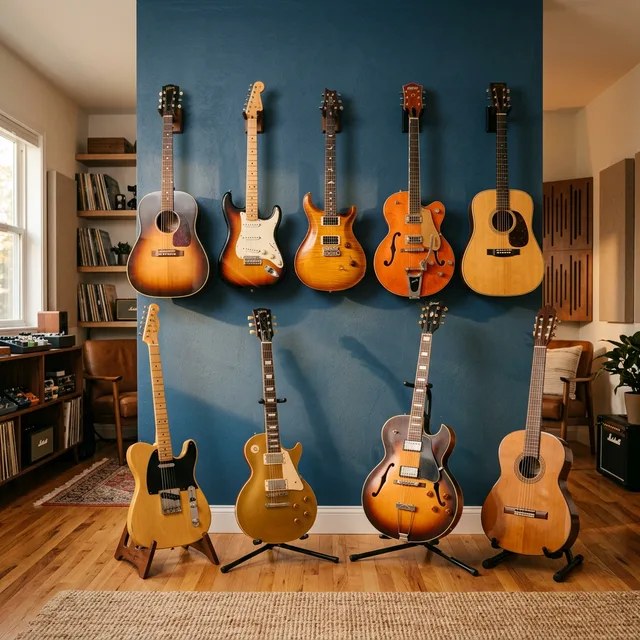
Wall hangers are hooks that mount directly to your wall. They hold the guitar by the headstock, letting the body hang down. This is the ultimate space-saving solution if you have a small room. It also keeps your guitars out of reach of curious toddlers and pets, who can easily knock over floor stands.
Floor stands are more portable and do not require you to drill holes in your walls. They are ideal if you live in a rental property or need to bring your gear to different locations. Floor stands are also better if you frequently switch instruments during a performance, as you can lift the guitar straight off the stand without reaching up to the wall.
Why is Nitrocellulose Lacquer Compatibility a Major Concern for Stands?
Many premium acoustic and electric guitars are finished with nitrocellulose lacquer. This lacquer is a traditional finish that allows the wood to breathe and age naturally. However, nitrocellulose is highly reactive. If it stays in contact with standard rubber, neoprene, or plastic for long periods, a chemical reaction occurs.
This reaction melts the lacquer, leaving permanent dark stains or gooey spots where the guitar rested on the stand. These marks ruin the value of the instrument. Cheaper stands are notorious for causing this damage. If you own a guitar with a nitro finish, you must verify that your stand uses nitro-safe foam or cloth padding to cover the contact points.
When Should You Choose a Multi-Guitar Rack Over Single Stands?
If you own three or more guitars, buying individual stands takes up a massive amount of floor space. Single stands have wide legs that collide with each other, creating a messy and unsafe setup. A multi-guitar rack is a much better solution for organizing a growing collection.
Multi-guitar racks hold three, five, or seven guitars side-by-side in a single frame. The Gator Frameworks Multi-Guitar Rack holds up to five guitars and folds down for easy transport. Racks keep your instruments tightly packed but separated by padded dividers. This setup is much more stable than having multiple single stands scattered around your room.
What Makes Hercules Wall Hangers and Stands the Industry Standard?
Hercules is widely considered the gold standard for guitar stands and wall mounts. Their stands use an Auto Grip System (AGS) that automatically locks the guitar in place. When you place the neck of the guitar into the yoke, the weight of the instrument pulls the yoke down, which rotates two protective barriers over the front of the neck.
The Hercules GS414B Plus Single Stand and the Hercules GSP38WB Plus Wall Hanger are built with heavy-duty steel and use special foam that is guaranteed to be safe for nitrocellulose finishes. The security of the auto-locking mechanism gives you peace of mind that a bump will not send your guitar falling to the floor.
How Do Wooden Guitar Stands Compare to Metal Options?
Wooden guitar stands are designed to look like furniture. They are usually made of solid hardwood like oak, walnut, or mahogany. These stands are popular for living rooms and home studios because they look much better than black metal tubing. They turn your instrument into a display piece.
Metal stands are built for utility and portability. They are lighter, fold down smaller, and can survive the abuse of touring. While a wooden stand looks beautiful in a living room, it is heavy and prone to scratching if you move it from gig to gig. For home use, wood is a great option, but metal remains the choice for active musicians.
Why are Neck Cradles and Safety Straps Crucial for Stand Security?
The neck cradle is the point where the stand holds the upper part of the guitar. Without a lock or strap at this point, a guitar can easily tip forward out of the bottom cradle. This is the most common way guitars fall from standard tripod stands.
A safety strap or auto-locking gate keeps the neck of the guitar secured inside the cradle. If someone trips over your cable, the guitar will wiggle but remain locked in the stand. Always make sure the safety strap is closed when you leave your guitar. Skipping this step defeats the purpose of having a secure stand.
What are the Best Portable Guitar Stands for Gigging Musicians?
Gigging musicians need stands that are lightweight, durable, and quick to set up. A-frame stands are very popular for gigging because they fold flat and slip into the front pocket of a gig bag. They take up very little space on a crowded stage.
Another popular choice for gigging is the mini tripod stand. These stands have a folding neck support that collapses down to a very small size. When choosing a gigging stand, look for metal construction and locking leg pins. Avoid stands with loose plastic parts that can break during transport in the back of a van.
How Can You Prevent Your Stand from Tipping Over on Stage?
Stages are chaotic environments with cables, feet, and mic stands constantly moving. To prevent your stand from tipping over, you must place it in a safe location. Never put your stand directly next to a doorway, monitor wedge, or in the middle of a walking path.
Place the stand behind your amplifier or next to the drum riser where people are less likely to walk. If you are using a tripod stand, point one of the three legs directly forward. This design makes the stand much harder to tip forward if someone pulls on your instrument cable. If you are using a beginner acoustic guitar or a metal electric guitar, keeping your cables neat is just as important as having a stable stand.
Buying notes (what to check before you click)
Listing checks Amazon copy skips. Stand and hanger street prices on this page are a research snapshot, not a live offer.
Use-case fit
- Daily practice, one guitar, floor space: Hercules-style auto-grip neck cradle. Search the Plus yoke, not a generic “Hercules-type” clone: Hercules GS414B Plus. Inventory sibling: best guitar stands.
- Small room, pets, kids: wall hanger into a stud, not drywall anchors. Pair with the guitar learning timeline habit of leaving the guitar out.
- Pointy ESP / V / Explorer: deep cradle or hanging yoke. Brand path: how to choose an ESP guitar.
- Nitro Gibson / Martin / PRS: certified nitro-safe foam or cloth, not surgical tubing.
When to skip / when to buy
- Skip a $12 tubular stand on a nitro finish. Cheap rubber is how finishes melt.
- Skip drywall-only hangers for a 9 lb electric. Stud or it is a floor stand.
- Skip an A-frame for a top-heavy bass or a Flying V. The body is the only support.
- Buy the GS414B Plus if knockover is the fear. Buy a folding A-frame if the stand has to live in a gig bag.
Listing checks the product title usually omits
- Nitro-safe foam vs surgical tubing. “Soft rubber” is the finish-killer phrase.
- GS414B vs GS414B Plus vs GSP38WB. Floor stand vs wall hanger share a brand.
- A-frame vs neck-cradle vs multi-rack. A “5-guitar stand” thumbnail can be five colliding A-frames.
- Auto-grip yoke vs a brittle neck strap. The strap is the part that ages out.
- Weight rating and footprint. Bass and 7-string bodies need a deeper lower cradle.
Next reads: guitars hub · best music gear roundups.
FAQ
Is it safe to hang expensive guitars on the wall?
Yes, hanging guitars on the wall is safe if you use high-quality wall hangers anchored into wall studs. Professional hangers like Hercules use auto-locking gates that close under the weight of the guitar, preventing it from slipping out.
What is nitrocellulose lacquer safety for guitar stands?
Nitrocellulose lacquer is a traditional finish used on high-end guitars that reacts chemically with standard rubber or surgical tubing on cheap stands. This reaction melts the finish, leaving permanent black scars on the neck and body of the guitar.
Are A-frame stands safe for bass guitars?
A-frame stands are safe for bass guitars if they are designed with deep cradles that can handle the body shape. However, because bass guitars are longer and heavier, a neck-suspending tripod stand or a multi-guitar rack offers much better stability.
Can I leave my guitar on a stand all the time?
Yes, you can leave your guitar on a stand if the room has controlled humidity (between 45% and 55%) and is free from pets or small children. If your home has dry winter air, storing your guitar in its hardshell case with a humidifier is safer.
Do wall hangers damage the neck of a guitar?
No, wall hangers do not damage the neck. The weight of the guitar hanging from its headstock does not put enough stress on the wood to cause structural damage. In fact, hanging a guitar vertically keeps it straight and away from floor-level accidents.
Actionable Conclusion
To select the right guitar stand, identify your guitar’s finish first. If your instrument has a nitrocellulose finish, purchase a certified nitro-safe stand from a brand like Hercules. Next, consider your space. Use wall hangers to save floor space, a multi-guitar rack for larger collections, or a folding A-frame stand for gigging. Protecting your guitar with a high-quality stand ensures your instrument remains safe and ready to play.

Music Gear Specialist Review Desk
Research-based reviewsResearch-based reviews · Manufacturer specs · Verified owner feedback
We review guitars, amps, pedals, and recording gear the honest way: spec sheets, published measurements, and the collected experience of working musicians and verified owners.