How to Choose a Taylor Guitar: Core Series and Body Shapes Compared
Compare Taylor guitar models in 2026. Learn the differences between Grand Auditorium and Grand Concert shapes, V-Class bracing, and series 100 to 800.
Music Gear Specialist Review Desk
Gear Research & Analysis
ℹ️ Affiliate Disclosure: Music Gear Specialist earns from qualifying purchases through Amazon and other partner links. This doesn't affect our recommendations—we only suggest gear we'd use ourselves.
Taylor Guitars is famous for modern engineering, fast-playing necks, and bright, clear acoustic tones. Deciding between their various body shapes and numbered series can be overwhelming for buyers. This guide simplifies the Taylor lineup, comparing shapes, bracing styles, and models in 2026.
Executive Summary
| Taylor Series | Wood Construction | Manufacturing Location | Target Player | Typical Price |
|---|---|---|---|---|
| Academy | Solid top, layered sides | Mexico | Beginners | $500 - $800 |
| GS Mini | Solid top, layered sides | Mexico | Travelers & Couch players | $600 - $1,000 |
| 100 & 200 Series | Solid top, layered sides | Mexico | Gigging musicians on budget | $800 - $1,500 |
| 300 & 400 Series | All solid wood (USA) | USA | Professionals | $1,800 - $2,600 |
| 500 Through 800 | Premium solid woods (USA) | USA | Collectors & Pros | $3,000 - $4,500+ |
Why is Taylor Guitars Known for Modern Innovation?
Bob Taylor founded Taylor Guitars in 1974 with a focus on improving acoustic guitar construction. Unlike traditional manufacturers who relied on centuries-old techniques, Taylor embraced modern manufacturing technology. They introduced computer-controlled cutting machines and laser systems to ensure precision.
One of their biggest breakthroughs was the bolt-on NT neck design, which allows for quick neck angle adjustments. Taylor also pioneered environmentally sustainable wood sourcing, creating programs to plant ebony trees and use alternative woods like urban ash. This focus on technology and conservation makes their guitars highly reliable.
How Do Taylor Body Shapes (Grand Auditorium, Grand Concert, Grand Symphony) Compare?
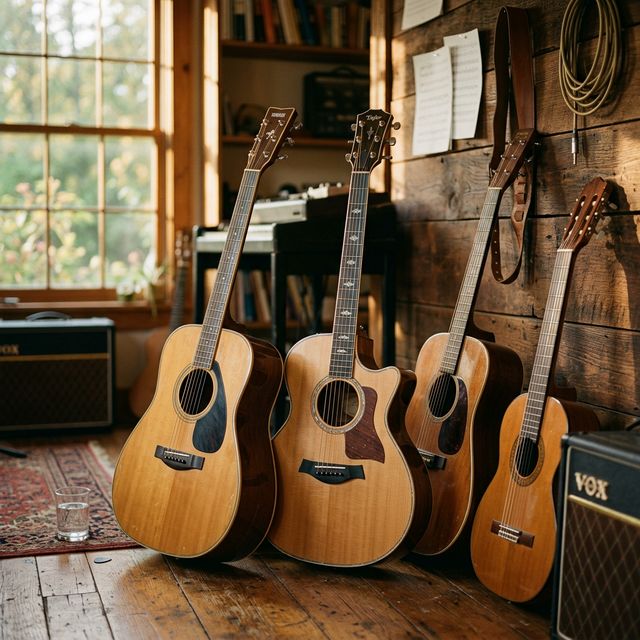
The Grand Auditorium (GA) is Taylor’s signature shape and most popular model. The Taylor 814ce Grand Auditorium is the flagship guitar. The GA has the width of a dreadnought but a narrower waist. This design makes it comfortable to hold while producing a highly versatile sound that handles heavy strumming and light fingerpicking equally well.
The Grand Concert (GC) is Taylor’s smallest full-size body shape. The GC has a shorter neck scale length and lower string tension, making it easy to fret notes. It produces a quiet, intimate tone that is highly popular for fingerstyle playing and recording. Its compact size is perfect for players with smaller hands.
The Grand Symphony (GS) is slightly larger than the Grand Auditorium, featuring a wider lower bout. It features a soundport cutaway that acts as a second soundhole, projecting sound in a wider arc. The GS produces a deep, piano-like bass and high volume, making it excellent for dynamic strumming and orchestral-style playing.
What is V-Class Bracing and How Does it Affect Sustain and Intonation?
Bracing refers to the wooden struts glued inside the guitar’s top soundboard. For decades, the industry standard was X-bracing, which allowed the top to vibrate while keeping it stable. In 2018, Taylor’s master designer Andy Powers introduced V-Class bracing, which uses a V-shape pattern instead of an X.
V-Class bracing allows the soundboard to be stiff along the length of the strings while remaining flexible on the sides. This configuration increases volume and sustain, letting notes ring out for a long time. It also improves intonation, meaning notes played up the neck stay perfectly in tune with open strings, eliminating the warbling sound common in older acoustics.
What Do Taylor Naming Conventions and Numbers Mean?
Taylor uses a three-digit number system to identify most of their acoustic guitars. The first digit represents the series (from 100 to 900), which indicates the wood combinations and ornamentation level. The second digit indicates the number of strings and top wood (1 for a six-string with a softwood top like spruce, 2 for a six-string with a hardwood top like mahogany).
The third digit represents the body shape. Grand Concert models end in 2, Grand Auditoriums end in 4, Grand Symphonies end in 6, and Grand Orchestras end in 8. Therefore, a Taylor 314ce is a 300-series (sapele/spruce) six-string Grand Auditorium with a cutaway (c) and electronics (e).
How Does the Taylor Academy Series Benefit Beginners?
The Academy Series was designed to eliminate the common barriers that cause beginners to quit playing guitar. These models feature a built-in armrest bevel on the upper edge of the body. This bevel prevents the sharp edge of the wood from cutting into your forearm during long practice sessions.
The Taylor Academy 10 features a dreadnought body shape with a slightly shorter scale length than standard guitars. This reduces string tension, making it easier for new players to hold down chords. If you want a comfortable starter guitar, the Academy Series is a great alternative to the standard beginner acoustic guitars.
Why is the Taylor GS Mini a Worldwide Success?
The GS Mini is a scaled-down acoustic guitar that has become one of the best-selling acoustic models in history. It is small enough to fit in airplane overhead bins but features a scaled-down Grand Symphony body that projects like a full-size guitar. It is not just a travel guitar; many professional musicians use it as their primary writing tool.
The Taylor GS Mini Rosewood features a solid Sitka spruce top with layered rosewood back and sides. It has a surprisingly deep bass response and clear highs. The short 23.5-inch scale length makes bending strings incredibly easy, making it a fun couch guitar for players of all skill levels.
How Do Taylor 100 and 200 Series Compare to High-End Models?
The 100 and 200 Series are built in Taylor’s Mexican factory. They feature solid spruce or koa tops paired with layered wood back and sides. Layered construction uses a core of poplar wood sandwiched between thin veneers of rosewood, koa, or walnut.
The Taylor 214ce uses layered rosewood back and sides. These guitars do not feature V-Class bracing, using traditional forward-shifted X-bracing instead. While they lack the complex acoustic resonance of USA-made all-solid wood Taylors, they are highly stable in changing humidity and offer the same comfortable neck profile as Taylor’s expensive models.
What Defines the Professional 300 Through 800 Series?
The 300 Series is the starting point for Taylor’s USA-made, all-solid wood lineup. The Taylor 314ce features solid sapele back and sides paired with a solid spruce top. This combination offers a dry, punchy midrange that sits well in live performances. As you move up to the 400 and 700 Series, Taylor introduces premium woods like rosewood and koa.
The 800 Series represents the classic Taylor combination of solid Indian rosewood and solid spruce, featuring premium maple binding and thin finishes. All of these USA models feature V-Class bracing, deluxe hardshell cases, and premium cosmetic details. They are professional instruments built to last a lifetime.
What is the Taylor Expression System 2 Pickup?
Almost all acoustic-electric Taylor guitars feature the Expression System 2 (ES2) pickup. Traditional acoustic pickups use piezo crystals placed under the saddle. When the strings vibrate, the saddle presses down on the crystals, creating an electrical signal that can sound harsh and clacky.
The ES2 pickup features three individual sensors placed behind the saddle rather than under it. This placement captures the natural movement of the saddle as it moves back and forth, producing a much warmer and more natural acoustic sound when plugged into a PA system or acoustic amplifier. It is one of the most reliable pickup systems for live performances in 2026.
How Do You Care for a Bolt-On Taylor Neck?
Taylor’s NT neck design uses a patented spacer system to secure the neck to the body. If your guitar’s wood shrinks or expands due to humidity changes, the neck angle can warp. On a traditional acoustic, correcting this requires a costly neck reset where a luthier must steam the glue joint apart.
On a Taylor, a technician can unscrew the neck and swap the wooden spacers for different thicknesses. This adjusts the neck angle back to factory specifications in under fifteen minutes. To keep your Taylor neck in good shape, store the instrument on a safe guitar stand when practicing, and always choose the right acoustic vs electric guitar for your playing style.
Buying notes (what to check before you click)
Listing checks Amazon copy skips. Academy / GS Mini / 200 / 300 street prices on this page are a research snapshot, not a live offer.
Use-case fit
- First full-size acoustic, mixed strum and fingerstyle: Grand Auditorium, Mexico 200 or USA 300. Search the exact SKU, not “Taylor GA”: Taylor 214ce.
- Smaller hands or quiet recording: Grand Concert, not a Grand Symphony. Couch / overhead-bin: GS Mini, not a Baby Taylor photo titled as a Mini.
- Live PA work: confirm the
e(ES2) in the model name. A non-e314 is a different checkout. - After it arrives, record it with a condenser, not a cab dynamic — best guitar microphones. Neck angle and relief still follow how to set up a guitar.
When to skip / when to buy
- Skip an 814ce as a first Taylor. That is 800-series rosewood money, not a 214ce / 314ce gap.
- Skip “V-Class” as the only reason to jump from a 214ce. Mexico 200s use X-bracing on purpose; humidity stability is the feature.
- Skip a Grand Symphony if the player sits on a couch and wants a quieter guitar. GS is the louder, wider bout.
- Buy a 214ce if layered rosewood + ES2 + GA is the job. Buy a 314ce if all-solid USA + V-Class is the reason you are spending the extra thousand.
Listing checks the product title usually omits
- 214ce vs 314ce. Same GA silhouette, Mexico layered vs USA all-solid, X-brace vs V-Class.
- Academy 10 vs GS Mini vs 114ce. “Beginner Taylor” in a thumbnail can be any of the three.
candein the suffix. Cutaway and ES2 are optional; a 314 withoutewill not plug into a PA.- Softwood
1vs hardwood2in the middle digit. A 324 is not a 314 with extra sparkle — it is a hardwood top. - Left-hand and 12-string variants. The photo is often a right-hand six-string.
Jackson is the high-gain sibling, not a Taylor substitute: how to choose a Jackson guitar. Next reads: guitars hub · best music gear roundups.
FAQ
What is the difference between a Taylor Grand Auditorium and Grand Concert?
The Grand Auditorium (GA) is a mid-sized, versatile guitar that handles both strumming and fingerstyle, offering balanced volume and bass. The Grand Concert (GC) is smaller, has a shorter scale length, and is quieter, making it ideal for intimate fingerstyle playing and smaller hands.
Is V-Class bracing better than X-bracing?
V-Class bracing is not necessarily better, but it offers different tonal qualities. It improves sustain and ensures notes stay in tune with each other up the fretboard. Traditional X-bracing provides a warmer, more familiar vintage sound with a slightly looser bass response.
Where are Taylor guitars made?
Taylor Academy, GS Mini, Baby Taylor, 100 Series, and 200 Series models are built in Taylor’s factory in Tecate, Mexico. The 300 Series and all higher-numbered models are built in their primary factory in El Cajon, California, USA.
What is the difference between Taylor 200 and 300 series?
The Taylor 200 Series features a solid spruce or koa top with layered wood (laminated) back and sides, built in Mexico. The Taylor 300 Series is the entry point to Taylor’s USA-made, all-solid wood lineup, featuring solid mahogany or sapele back and sides and V-Class bracing.
What does the ‘ce’ mean in Taylor model names?
In Taylor model names, ‘c’ stands for cutaway, which is a scoop in the guitar body that allows easy access to the higher frets. The ‘e’ stands for electronics, indicating the guitar includes a built-in pickup and preamp system for plugging into an amplifier.
Actionable Conclusion
To choose the perfect Taylor guitar, decide between their body shapes first. If you need a versatile, do-it-all instrument, select a Grand Auditorium like the 314ce or 214ce. If you prefer fingerpicking or have smaller hands, select a Grand Concert model. For beginners, the Academy Series offers an affordable entry point, while the GS Mini is the ultimate choice for a travel-friendly companion. If you want a USA-built guitar with V-Class bracing, start your search at the 300 Series.

Music Gear Specialist Review Desk
Research-based reviewsResearch-based reviews · Manufacturer specs · Verified owner feedback
We review guitars, amps, pedals, and recording gear the honest way: spec sheets, published measurements, and the collected experience of working musicians and verified owners.