Best Acoustic Guitar Pickups for Live Performance
We researched 7 acoustic guitar pickups. The LR Baggs Anthem wins for natural tone, the Fishman Matrix for value, and the KQ Quik Stik for easy install.
Music Gear Specialist Review Desk
Gear Research & Analysis
ℹ️ Affiliate Disclosure: Music Gear Specialist earns from qualifying purchases through Amazon and other partner links. This doesn't affect our recommendations—we only suggest gear we'd use ourselves.
ℹ️ Affiliate Disclosure: Music Gear Specialist earns from qualifying purchases through Amazon and other partner links. This doesn't affect our recommendations—we only suggest gear we'd use ourselves.
Your acoustic guitar sounds incredible unplugged. But the moment you need to be heard over a band, in a venue, or on a recording, you need amplification. The right pickup preserves your guitar’s natural voice while giving you the volume to fill a room.
TL;DR: The LR Baggs Anthem ($300) is the most natural-sounding acoustic pickup, dual-source mic + piezo. The Fishman Matrix Infinity ($150) is the best value undersaddle. For no-install convenience, the LR Baggs M1 Active ($130) clips into your soundhole in 10 seconds.
Our Top Picks
LR Baggs Anthem, Best Natural Tone
Price: ~$300 | Type: Dual-source (under-saddle + mic) | Install: Professional
The Anthem combines an undersaddle element for clarity and feedback resistance with a TRU•MIC internal microphone for natural body and air. The result is the most realistic amplified acoustic tone available. It’s the pickup of choice for professional touring singer-songwriters.
Best for: Professional performance, the most natural amplified tone, studio-quality live sound.
Fishman Matrix Infinity, Best Undersaddle
Price: ~$150 | Type: Undersaddle piezo | Install: Professional
The Matrix Infinity is Fishman’s flagship undersaddle pickup system. The narrow-format pickup sits cleanly under the saddle, and the onboard preamp (mounted inside the soundhole) provides volume, tone, and phase controls. Clean, reliable, feedback-resistant.
Best for: Gigging musicians, feedback-prone stages, reliable amplification.
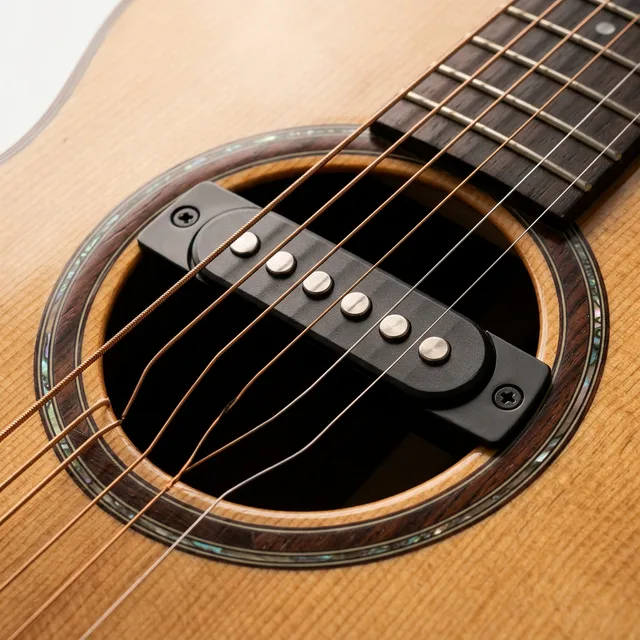
LR Baggs M1 Active, Best Soundhole Pickup
Price: ~$130 | Type: Magnetic soundhole | Install: DIY (10 seconds)
The M1 Active clips into any soundhole with no modification to your guitar. The active preamp provides a warm, body-rich tone that avoids the thin, harsh character of passive soundhole pickups. Remove it in seconds to go fully acoustic. Perfect if you don’t want to permanently modify your guitar.
Best for: No-modification pickup, quick install/removal, multiple guitar use.
K&K Pure Mini, Best Under-Top Contact
Price: ~$90 | Type: Contact (under bridge plate) | Install: Professional
The Pure Mini uses three transducer sensors bonded to the underside of the bridge plate. The result is a warm, woody tone that captures the guitar’s top vibrations directly. No battery required (passive system), and it avoids the piezo “quack” that some players hate.
Best for: Natural warm tone, passive simplicity, fingerstyle players.
Dean Markley Artist Transducer, Best Budget
Price: ~$30 | Type: Contact (stick-on) | Install: DIY (peel and stick)
The Artist Transducer sticks to the body of your guitar with adhesive. At $30, it’s the cheapest way to amplify an acoustic guitar. Tone is usable for practice and casual jams, though it lacks the refinement of premium pickups.
Best for: Absolute budget, experimental use, temporary pickup solution.
Fishman Rare Earth Blend, Best Premium Soundhole
Price: ~$250 | Type: Dual-source (magnetic + mic) | Install: DIY
The Rare Earth Blend combines a magnetic soundhole pickup with a miniature internal condenser microphone. A blend control lets you dial between the direct pickup sound and the mic’s natural ambiance. Premium build quality with a hum-canceling stack design.
Best for: Premium soundhole pickup, dual-source blending, players who switch guitars.
What to Look For in an Acoustic Guitar Pickup
Amplifying an acoustic guitar is one of the trickiest audio challenges in live music. The goal is to capture what makes your acoustic sound good, warmth, resonance, natural dynamics, without the feedback, thin tone, or harsh “electric-ish” sound that plagues budget pickups.
Pickup type determines tone character: Undersaddle pickups (like the Fishman Matrix) are the most feedback-resistant and consistent option for loud venues, but they tend to sound slightly “quacky” or thin without good EQ work. Contact/soundboard transducers (K&K Pure Mini) transmit the vibrations of the guitar top directly, giving a more natural, woody tone, but they’re more feedback-prone at high volumes. Dual-source systems (LR Baggs Anthem, Fishman Rare Earth Blend) combine a pickup with a microphone for the natural sound of a mic with the feedback rejection of a pickup.
Installation complexity: Some pickups can be self-installed in 10 minutes with no modifications to your guitar (soundhole magnetic pickups, stick-on contact pickups). Undersaddle systems require removing the saddle, routing the endpin for the jack, and ideally a professional setup. Budget at least $50–75 in labor for a professional undersaddle installation.
Preamp and EQ: Built-in preamps with onboard EQ (bass, mid, treble) give you control on stage without relying on the PA engineer. Passive pickups without preamps are simpler and have no battery to die mid-gig, but require a DI box or preamp in your signal chain.
Battery life and footprint: Active pickups run on 9V batteries lasting 100–200 hours. The worst thing that can happen is your battery dying mid-set, keep a spare in your gig bag and replace batteries every 3 months of regular gigging.
Acoustic Pickup Comparison
| Pickup | Price | Type | Install | Battery | Best For |
|---|---|---|---|---|---|
| Dean Markley | $30 | Contact | DIY | No | Budget |
| K&K Pure Mini | $90 | Contact | Pro | No | Warm tone |
| LR Baggs M1 | $130 | Magnetic | DIY | Yes | No-mod solution |
| Fishman Matrix | $150 | Undersaddle | Pro | Yes | Gigging |
| Fishman Rare Earth | $250 | Dual-source | DIY | Yes | Premium soundhole |
| LR Baggs Anthem | $300 | Dual-source | Pro | Yes | Most natural |
Keep Reading
- Best Acoustic Guitars for Beginners, guitars that deserve pickups
- Acoustic vs Electric Guitar, choosing your path
- How to Record Guitar at Home, mic vs pickup for recording
We select and review gear independently. To learn more about our testing process, read our Editorial Policy.

Music Gear Specialist Review Desk
Research-based reviewsResearch-based reviews · Manufacturer specs · Verified owner feedback
We review guitars, amps, pedals, and recording gear the honest way: spec sheets, published measurements, and the collected experience of working musicians and verified owners.