Guitar Pedals Explained: What Do They Actually Do?
Overdrive? Fuzz? Delay? We break down the confusing world of guitar effects pedals simply, so you can build your first pedalboard without wasting money.
Music Gear Specialist Review Desk
Gear Research & Analysis
ℹ️ Affiliate Disclosure: Music Gear Specialist earns from qualifying purchases through Amazon and other partner links. This doesn't affect our recommendations—we only suggest gear we'd use ourselves.
To a non-guitarist, a pedalboard looks like the control panel of a spaceship covered in brightly colored, randomly flashing metal bricks. To a guitarist, it is an endless money pit known affectionately as “Tone Chasing.”
Guitar effects pedals (or “stompboxes”) are simply small analog or digital circuits designed to alter the waveform of the signal coming from your guitar before it hits your amplifier.
If you are just starting to augment your sound beyond your amplifier’s basic knobs, the market is incredibly overwhelming. There are literally thousands of boutique pedals available. Here is the ultimate demystification of the core categories so you can build your first rig.
The 5 Main Categories of Effects
Virtually every pedal on earth falls into one of five primary categories: Gain, Time-Based, Modulation, Dynamics, and Utility.
1. Gain: Dirt, Grit, and Power
Gain pedals are the foundation of rock, blues, and metal. They intentionally “distort” the clean sine wave of your guitar signal to add harmonic complexity and sustain.
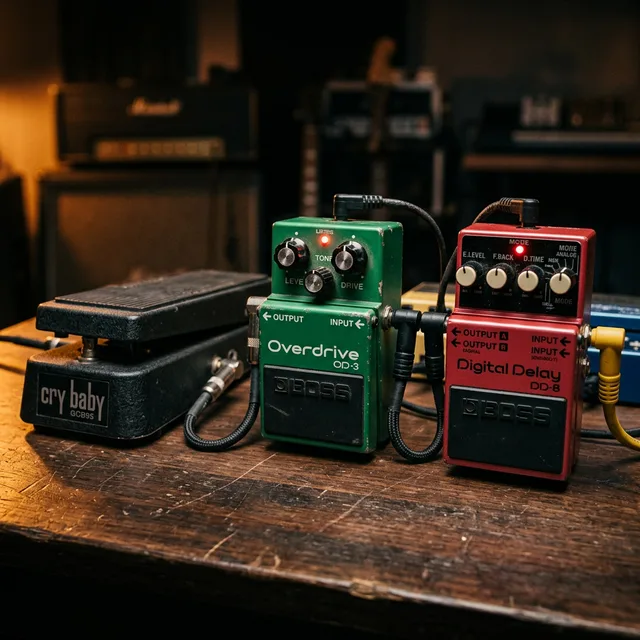
- Overdrive: The most subtle form. It sounds like an old tube amplifier being cranked up loud. It reacts cleanly when you play softly and “bites” when you dig in with your pick. Essential Pedal: Ibanez Tube Screamer or Boss SD-1.
- Distortion: Harder, heavier, and darker. Distortion pedals compress the signal heavily and impose a thick blanket of saturation. This is required for 90s alternative rock, punk, and metal. Essential Pedal: Boss DS-1 or ProCo RAT.
- Fuzz: The oldest guitar effect on record. It absolutely annihilates the signal wave into a sheer wall of crackling, sustained buzz. Essential Pedal: Electro-Harmonix Big Muff.
2. Time-Based: Creating Space
These pedals take your original signal, copy it, and manipulate when the copy is played back to you.
- Delay: An echo. It takes a note you played and repeats it back at a set interval. You can set it to repeat once quickly (slapback) or repeat forever until it fades into ambient noise. This makes solos sound huge and creates rhythmic textures. Essential Pedal: MXR Carbon Copy or Boss DD-8.
- Reverb: Simulates the physical acoustics of a space. Without reverb, your guitar sounds incredibly dry. A small amount of reverb makes it sound like you’re playing in a tiled bathroom; a large amount makes it sound like you are playing in an empty cathedral. Essential Pedal: TC Electronic Hall of Fame 2.
3. Modulation: Movement and Swirl
Modulation pedals constantly alter the pitch, volume, or phase of your signal using an internal low-frequency oscillator, creating a sense of syrupy, swirling movement.
- Chorus: Takes your signal, copies it, shifts the pitch of the copy very slightly, and delays it by a few milliseconds. It sounds like two guitars playing at once, making clean chords sound luxurious and “watery” (think 1980s Police or Nirvana). Essential Pedal: Boss CE-2w.
- Phaser/Flanger: Sweeps sweeping filters up and down across the frequency spectrum. It creates a swooshing, jet-engine sound across chords (think Van Halen’s “Ain’t Talkin’ ‘Bout Love”). Essential Pedal: MXR Phase 90.
- Tremolo: Rhythmically drops the volume of your signal up and down in a pulsing wave. This is a classic sound in surf rock and spaghetti western soundtracks.
4. Dynamics: Controlling the Wildness
Dynamics pedals don’t drastically alter the flavor of your tone; they control the geometry of the volume wave.
- Compressor: The secret sauce of country and funk players. A compressor takes the loudest notes you play and turns them down, while taking the quietest notes you play and turning them up. It evens out your volume and adds immense, clean sustain without needing distortion. Essential Pedal: Keeley Compressor Plus.
5. Utility: The Boring but Essential Ones
- Tuner Pedal: Mutes your signal entirely while displaying an ultra-accurate LED readout so you can tune your guitar silently on stage. The most boring pedal you will buy, but the single most important one on your board.
- Looper: As discussed in our amplifier guide, a looper records a phrase of input and plays it back constantly so you can practice scales or layer harmonies over yourself.
How Do You Power Them?
A single pedal can run on a standard 9-volt battery. But if you have five pedals and you accidentally leave the cables plugged in overnight, you will wake up to five dead batteries.
When you build a board, you must buy an Isolated Power Supply (like a Voodoo Lab Pedal Power or a Truetone CS7).
A power supply mounts underneath your pedalboard and provides clean, dedicated power lines to each pedal. Why does it need to be “isolated”? If you use a cheap “daisy-chain” cable to power five pedals from one wall wart adapter, digital pedals (like complex delays) will leak high-frequency digital noise backward through the power cable into your analog overdrive pedals, resulting in a horrible whining hiss that ruins your tone. Clean power is essential.
And do not assume any adapter from your junk drawer will do — if you have ever wondered whether any random power supply will work for your pedals, the short answer is no, because voltage, polarity, and current draw all have to match the pedal exactly.
Your First Board: The 3-Pedal Strategy
If you want to start building a physical pedalboard, do not drop $800 on six pedals at once. You won’t know how to use any of them properly. Start with this Holy Trinity:
- A Tuner (Pitchblack or Boss TU-3)
- An Overdrive (Boss SD-1 or Wampler Tumnus)
- A Delay (Boss DD-8 or MXR Carbon Copy)
Master those three over the course of six months. Once you learn how to push an overdrive pedal using the volume knob of your guitar, and learn how to sync a delay time to the tempo of a song, you will have the foundational knowledge required to plunge down the rabbit hole of advanced effects.
Related Reading

Music Gear Specialist Review Desk
Research-based reviewsResearch-based reviews · Manufacturer specs · Verified owner feedback
We review guitars, amps, pedals, and recording gear the honest way: spec sheets, published measurements, and the collected experience of working musicians and verified owners.