Stratocaster vs Telecaster: Which Fender is Right for You?
The two most iconic guitars in history demystified. We compare the twang of the Tele with the quack of the Strat so you can find your perfect tone.
Music Gear Specialist Review Desk
Gear Research & Analysis
ℹ️ Affiliate Disclosure: Music Gear Specialist earns from qualifying purchases through Amazon and other partner links. This doesn't affect our recommendations—we only suggest gear we'd use ourselves.
Leo Fender got it right twice. In 1950, he revolutionized the music world by releasing the Broadcaster (later renamed the Telecaster)—the first commercially successful solid-body electric guitar. Four years later, he released the Stratocaster, a futuristic, contoured instrument that looked like a space-age hot rod.
Seventy years later, these two instruments still account for over half of all electric guitars sold globally. But despite sharing the same logo on the headstock and the same 25.5-inch scale length, they are radically different tools. Here is the definitive breakdown of the Stratocaster versus the Telecaster.
Comfort and Ergonomics
The physical feeling of holding these guitars against your body is the first major difference you will notice.
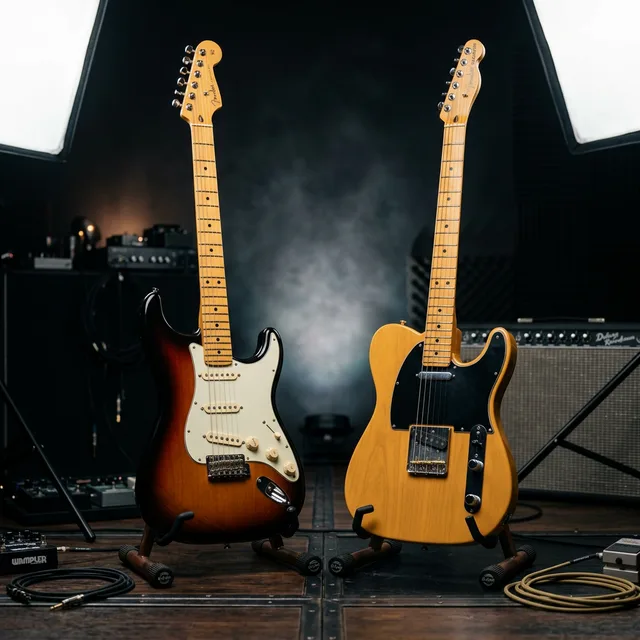
The Telecaster (Slab Body): The Telecaster is essentially a large, flat cutting board. It has no physical contours to conform to the human body. Because its edges are completely squared off, it tends to dig into the player’s ribs when sitting down, and the sharp top edge can put uncomfortable pressure on the forearm of your strumming hand. It feels raw, utilitarian, and unapologetic.
The Stratocaster (Contoured Body): The Stratocaster is a masterpiece of ergonomic industrial design. It features a massive “tummy cut” carved out of the back, allowing it to hug the player’s torso securely. The top right edge features a deep “forearm contour,” providing a smooth resting slope for the picking arm. Also, the Strat has a top and bottom “horn” (cutaway), whereas the Telecaster only has a bottom cutaway. The Strat provides vastly superior upper-fret access for high solos.
The Hardware: Bridges and Tremolos
This is where the engineering philosophies sharply diverge.
The Telecaster “Ashtray” Bridge: The Tele features a massive steel plate bolted directly to the wood of the body. The strings anchor through the back of the wood and come up over three or six brass saddles. Because it is fixed, no matter how hard you bend the strings or rest your palm on the bridge, the tuning remains exceptionally stable.
The Stratocaster “Floating” Tremolo: The Stratocaster features a mechanical bridge that balances on a knife-edge against the tension of heavy springs routed into the back of the guitar body. By attaching a metal “whammy bar,” the player can physically push or pull the bridge to raise or lower the pitch of all six strings simultaneously. This allows for deep, expressive vibrato, but introduces a massive flaw: if you break a string while performing, the tension balance is ruined, and all remaining five strings will instantly drop out of tune.
The Sound: Quack vs. Twang
If you close your eyes, you can easily tell the difference between these two instruments.
The Stratocaster: Versatility and Quack
The Strat has three pickups (Neck, Middle, Bridge) and a 5-way selector switch.
- Positions 2 and 4: By combining the Middle pickup with either the Neck or Bridge pickup, the magnetic frequencies cancel out specific midrange bands. This results in the famous “quack” tone—a hollow, distinctly glassy sound used heavily in funk music (Nile Rodgers), John Mayer records, and Mark Knopfler’s fingerpicking.
- The Neck Pickup: Thick, round, and bell-like. It is the definitive sound of electric blues (Stevie Ray Vaughan, Jimi Hendrix).
The Telecaster: Honesty and Twang
The Telecaster only has two pickups and a 3-way switch. It is a simpler, more brutally honest instrument.
- The Bridge Pickup: This is the weapon. Mounted in the massive steel bridge plate, this pickup screams. It produces an aggressive, biting high-end known universally as the “Country Twang.” It cuts through a dense band mix better than almost any other guitar pickup on earth.
- The Neck Pickup: Housed underneath a small chrome cover, the Telecaster neck pickup is softer, quieter, and darker than a Stratocaster neck pickup. It shines in creating warm, mellow tones for jazz chord melodies.
- The Middle Position: Combining both the bridge and neck pickups produces a beautiful, even, hi-fi sounding rhythm tone that sits perfectly inside a jangly pop arrangement.
Which One Should You Buy?
Choosing between a Stratocaster and a Telecaster typically comes down to your playing style and stage requirements.
Choose the Stratocaster if:
- You want extreme versatility. The three pickups and 5-way switch allow you to play blues, pop, hard rock, and funk smoothly.
- You play lead guitar and want the expression of the tremolo (whammy) bar.
- You value physical comfort during three-hour gigging sets.
Choose the Telecaster if:
- You want an instrument that stays perfectly in tune despite aggressive hybrid picking and massive string bends.
- You play country, indie rock, or punk, and require an aggressive, cutting bridge tone that drives a vacuum tube amplifier into thick distortion.
- You believe “limitations breed creativity.” The lack of a middle pickup, the lack of a whammy bar, and the utilitarian slab body force you to focus entirely on the raw emotion of your fingers.
Buying notes (what to check before you click)
Listing checks Amazon copy skips. Player / Professional / Classic Vibe street prices on this page are a research snapshot, not a live offer.
Use-case fit
- Three-hour sitting set, funk or blues quack, want a tremolo bar: Stratocaster, contoured body, 5-way. Search the current Player, not a photo of an Ultra: Fender Player Stratocaster.
- Hybrid picking, big bends, country or indie cut: Telecaster, ashtray bridge, 3-way. Search the Player Tele, not a Broadcaster relic listing: Fender Player Telecaster.
- First gig guitar and you rest a palm on the bridge: Tele, or a hardtail Strat — not a floating trem you have never set.
- Shape first, factory later. Whether a Mexican Player is “enough” is are expensive guitars worth it. What you plug that guitar into is signal chain order.
When to skip / when to buy
- Skip a floating-trem Strat as a first gig guitar if you rest your palm. A broken string dumps the other five out of tune.
- Skip an American Professional II because the silhouette matches a Squier thumbnail. The factory and the trem block are the checkout.
- Skip a Nashville Tele (three pickups) if you wanted the two-pickup ashtray voice this page describes.
- Buy a Player Tele if tuning stability and twang are the job. Buy a Player Strat if quack plus a contour is the job.
Listing checks the product title usually omits
- Player vs American Professional vs Squier Classic Vibe. Same headstock shape, three fretwork and pickup grades.
- SSS vs HSS. A “Strat” thumbnail can hide a bridge humbucker; quack positions 2 and 4 change.
- Floating trem vs hardtail Strat. “Synchronized tremolo” in the title is not a six-screw you can deck and ignore.
- 3-saddle vs 6-saddle Tele. Intonation vs vintage look — the listing photo will not say which.
- Left-hand and Maple vs rosewood board. The lifestyle shot is usually a right-hand maple Player.
Next reads: guitars hub · best music gear roundups.
Related Reading

Music Gear Specialist Review Desk
Research-based reviewsResearch-based reviews · Manufacturer specs · Verified owner feedback
We review guitars, amps, pedals, and recording gear the honest way: spec sheets, published measurements, and the collected experience of working musicians and verified owners.