Valve Amps vs Tube Amps: Are They Different?
Valve amps vs tube amps explained: why the terms mean the same thing, how they compare with solid-state amps, and what guitarists should buy.
Music Gear Specialist Review Desk
Gear Research & Analysis
ℹ️ Affiliate Disclosure: Music Gear Specialist earns from qualifying purchases through Amazon and other partner links. This doesn't affect our recommendations—we only suggest gear we'd use ourselves.
If you walk into any guitar forum on the internet and ask, “Should I buy a tube amp or a solid-state amp?”, you will instantly start a holy war. The debate over amplifier technology involves more mythology, snake-oil, and stubborn traditionalism than almost any other topic in music production.
This is a research-desk explainer, not a scored A/B of a house fleet. Tube vs modeling / hybrid notes below come from published circuit descriptions and the listing twins Amazon keeps collapsing into one “guitar amp” silhouette. Music Gear Specialist Review Desk did not blind-test a boutique head against a Katana to write this.
Valve Amps vs Tube Amps: Quick Answer
Valve amps and tube amps are the same thing. The difference is regional language, not circuit design. In the UK, Australia, and parts of Europe, players often say valve amp. In the United States, players usually say tube amp. Both refer to guitar amplifiers that use vacuum tubes, also called valves, in the preamp, power amp, or both.
So if you are comparing valve amps vs tube amps, there is no tonal difference to compare. The real decision is valve/tube amp vs solid-state or modeling amp.
| Term | Usually used in | Means |
|---|---|---|
| Valve amp | UK, Australia, Commonwealth markets | Guitar amp using vacuum tubes/valves |
| Tube amp | United States and many online retailers | Guitar amp using vacuum tubes/valves |
| Solid-state amp | Global | Guitar amp using transistor, analog, or digital modeling circuits |
If you want a direct listening-test comparison, read our valve amp vs solid state blind test. If you want a buying decision, read the solid state amps vs tube amps guide.
In the 1960s, vacuum tubes were the only way to make a guitar loud. In the 1980s, cheap transistor “solid-state” amps arrived, offering insane reliability but terrible, buzzing tone. Today, in 2026, the technology has evolved so drastically that the lines are blurring.
Here is the objective truth regarding Tube vs. Solid-State amplifiers, completely stripped of the marketing hype. If you searched for valve amp vs solid state, the terminology is the same: valve amp is the UK/Commonwealth name for a tube amp.
What is a Tube Amplifier?
A tube amplifier uses physical, glowing vacuum tubes (valves) to take the microscopic electrical signal from your guitar pickups and multiply it aggressively until it is powerful enough to physically push a heavy cardboard speaker cone.
There are two main sections: The Preamp: Uses small tubes (like 12AX7s) to shape the EQ (Treble, Mids, Bass) and add initial gain (crunch). The Power Amp: Uses massive, burning-hot tubes (like EL34s or 6L6s) to take that shaped signal and multiply its raw volume.
The Magic of “Tube Saturation”
If you demand extreme transparency from an amplifier, a tube amp is technically “broken.” When you send too much signal into a vacuum tube, it cannot handle the voltage accurately. It begins to round off the peaks of the audio waveform.
This rounding-off creates a deeply complex, syrupy distortion that reacts organically to human touch. If you hit the strings softly, the amp stays clean. If you dig in aggressively with a heavy pick, the tube begs for mercy and “breaks up” into gorgeous, harmonically rich overdrive. This dynamic “feel” is why blues, classic rock, and indie players swear by tubes.
What is a Solid-State Amplifier?
Solid-State (or Transistor) amplifiers completely abandon fragile glass tubes. They use silicon transistors and integrated circuits to magnify the guitar signal.
For decades, solid-state amps were despised because transitors do not round off waveforms gently. If you push a raw analog transistor too hard, it bluntly “clips” the top off the waveform, creating a horrific, ear-piercing static buzz. Consequently, solid-state amplifiers must be designed with massive headroom to remain perfectly clean at all times, relying on distortion pedals to provide the grit.
The Rise of Digital Modeling
In 2026, purely analog solid-state amps are rare. They have been replaced by Digital Modeling Amps (which are solid-state power platforms driven by supercomputers).
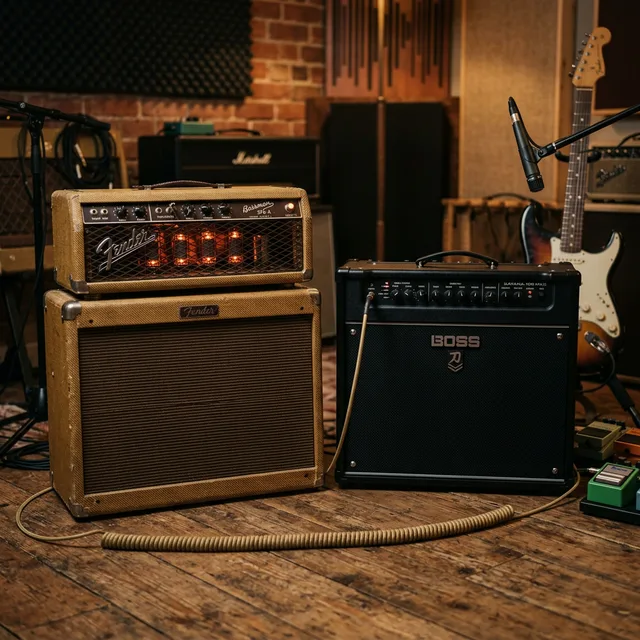
Amps like the Boss Katana or the Fender ToneMaster series use incredibly complex algorithms to physically simulate the exact mathematical wave degradation of a vacuum tube failing under stress. They then push that finalized digital equation out through a massive, ultra-clean solid-state power section.
Head-to-Head Comparison
If you are torn between traditional glass bottles and modern digital processors, examine these critical operational differences:
1. Volume and the “Sweet Spot”
Tube Amps: A 50-watt tube amp has a “sweet spot” at around 6 on the volume dial, where the power tubes begin to sweat and compress organically. The problem? A 50-watt amp on 6 will literally shake the drywall off your house. They sound anemic at whisper volumes. Solid-State: A modeling amp sounds exactly the same at 1% volume as it does at 100% volume because the distortion is entirely algorithmic, not reliant on physical acoustic pressure. They are exponentially superior for bedroom practice.
2. Weight and Reliability
Tube Amps: They rely on massive, heavy copper transformers. A standard Vox AC30 tube amp weighs nearly 75 pounds and contains glass tubes that shatter if the amp is dropped off a stage. The tubes also wear out naturally and cost $150 to replace every few years. Solid-State: A Fender ToneMaster Twin Reverb uses Class-D digital power and neodymium speakers. Handlers can pick up a massive 2x12 amplifier with their pinky finger (it weighs 33 pounds). If you drop it down the stairs, it will likely still turn on flawlessly.
3. Tonal Versatility
Tube Amps: Generally, they do “one thing” incredibly well. A Marshall stack does crunch. A Fender Princeton does ambient cleans. If you want a tube amp to do both, you need a massive pedalboard. Solid-State: A digital modeling amp contains flawless recreations of the Marshall, the Fender, a Mesa Boogie, a Roland Jazz Chorus, and 80 different boutique pedals inside its internal software. You can switch from 60s Surf Rock to 2010s Djent Metal with the tap of a footswitch.
The Verdict: Which Should You Buy?
In 2026, the digital modeling amps have become so microscopically accurate that in a blind “A/B Test” inside a dense mix, professional engineers routinely cannot distinguish the $400 digital clone from the $3,000 vintage tube original.
Buy a Tube Amp If: You are an analog purist. You play highly dynamic blues/jazz where the specific tactile “sag” of a power tube dictates your phrasing. You play regular loud gigs and have the budget ($1,000+) and lower-back health to haul transformers around.
Fender Blues Junior IV Tube/Valve Amp
Buy a Solid-State Modeling Amp If: This is your first amplifier. You live in an apartment with neighbors. You play in a cover band spanning five decades of different genres. You record via USB directly into your laptop.
Boss Katana 50 MkII Modeling Amp
A Pacifica or other first electric often wants this modeling / THR lane, not a glass bottle — how to choose a Yamaha guitar. When you do mic a real cab, start with how to mic a guitar amp.
Buying notes (what to check before you click)
Listing checks Amazon copy skips. Blues Junior / Katana / THR street prices on this page are a research snapshot, not a live offer.
Use-case fit
- Apartment / bedroom, same tone at whisper volume: Boss Katana 50 or a Yamaha THR. Distortion is in the algorithm, not the power tubes.
- Club volume, one analog voice, you will mic the cab: a small tube combo such as the Fender Blues Junior. Placement after the buy: how to mic a guitar amp.
- First electric in the Yamaha lane (Pacifica / THR): how to choose a Yamaha guitar, then a modeler — not a 50-watt glass head.
When to skip / when to buy
- Skip a boutique tube head for apartment volume. A 50-watt “sweet spot at 6” is a drywall problem, not a tone problem you can EQ away.
- Skip a “tube amp” thumbnail that is a hybrid (tube preamp, solid-state power) if you wanted power-tube sag. The listing will still say “tube.”
- Skip USB-out as proof you do not need a mic. USB is the modeler path; a Blues Junior still needs a capsule.
- Buy modeling / THR if the room has neighbors. Buy a small tube combo if you play loud gigs and will maintain tubes. Buy a hybrid only if you can name “tube pre, solid-state power” as the reason.
Listing checks the product title usually omits
- real tubes vs modeling / hybrid listing. All-tube (pre + power), tube-pre / SS-power hybrid, and digital modeling are three checkouts under one “guitar amp” photo.
- Wattage vs bedroom. A 15-watt tube combo is not a 15-watt Katana.
- ToneMaster / Katana / THR vs a glass Deluxe. Lightweight Class-D plus a model is not a transformer and EL84s.
- Combo vs head-only. A boutique head still needs a cabinet and a mic, or a load box.
- Retube / bias vs “maintenance-free.” Glass bottles are consumables; a Katana is not.
Next reads: amps hub · best music gear roundups.
Related Reading

Music Gear Specialist Review Desk
Research-based reviewsResearch-based reviews · Manufacturer specs · Verified owner feedback
We review guitars, amps, pedals, and recording gear the honest way: spec sheets, published measurements, and the collected experience of working musicians and verified owners.