Stratocaster vs Telecaster: Choosing Your Fender
Strat or Tele? We break down pickups, body shape, tone, tremolo, and playability so you can pick the right Fender for your style and budget.
Mike Reynolds
Professional Guitarist & Audio Engineer · 20+ years
ℹ️ Affiliate Disclosure: Music Gear Specialist earns from qualifying purchases through Amazon and other partner links. This doesn't affect our recommendations—we only suggest gear we'd use ourselves.
ℹ️ Affiliate Disclosure: Music Gear Specialist earns from qualifying purchases through Amazon and other partner links. This doesn't affect our recommendations—we only suggest gear we'd use ourselves.
TL;DR: The Stratocaster wins for versatility (3 pickups, tremolo bar, contoured body) and comfort. The Telecaster wins for focused tone, simplicity, and that unmistakable twang. Both start at ~$850 for the Fender Player II series. Pick the one whose sound makes you want to play, you can’t go wrong.
The 60-Second Summary
The Stratocaster and Telecaster are the two most iconic electric guitars ever made, and they come from the same company. Leo Fender designed the Telecaster first (1950) and the Stratocaster second (1954), building on lessons learned. Both guitars have defined popular music for 70+ years, but they’re remarkably different instruments once you dig in.
Here’s the core difference: the Telecaster is a specialist; the Stratocaster is a generalist. The Tele does a few things incredibly well (twang, bite, country, indie rock). The Strat does almost everything well (blues, funk, rock, pop, jazz, R&B).
Body Shape & Comfort
This is where the two guitars differ most dramatically, and where beginners notice the biggest difference.
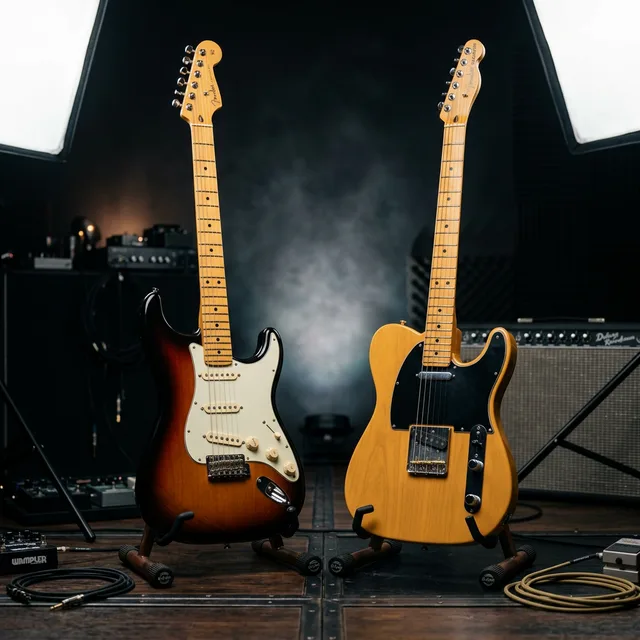
Telecaster: Single-cutaway, flat-slab body with squared-off edges. It’s the original electric guitar shape, designed for manufacturing simplicity. No belly contour, no forearm contour. It works, but extended playing sessions can dig into your forearm and ribs.
Stratocaster: Double-cutaway body with two key comfort features Leo added after hearing player complaints about the Tele: a forearm contour on the front and a belly cut on the back. These contours make an immediate difference, the Strat practically melts into your body. The double cutaway also provides significantly better upper-fret access.
Weight: Strats typically weigh 7-8 lbs; Telecasters run 8-9 lbs. Over a 3-hour gig, that pound matters.
Our experience: Every time we hand a Telecaster to a Strat player, they comment on the sharp edge pressing into their forearm within minutes. And every time we hand a Strat to a Tele player, they comment on how “slippery” it feels. Comfort is personal, but the Strat was literally engineered to be more ergonomic.
Pickups & Tone
This is where the real debate lives. The pickup configuration defines each guitar’s sonic character.
Telecaster Pickups
The Telecaster uses two single-coil pickups with a 3-way selector switch:
- Bridge pickup: Mounted on a metal plate, producing a bright, snappy, cutting tone with pronounced twang. This is the Telecaster sound, raw, aggressive, and perfect for country chicken-pickin’ or indie rock bite.
- Neck pickup: Covered in a metal cover, delivering a warmer, rounder, almost jazz-like tone with rolled-off highs.
- Both pickups together: A balanced blend that works for rhythm playing.
Stratocaster Pickups
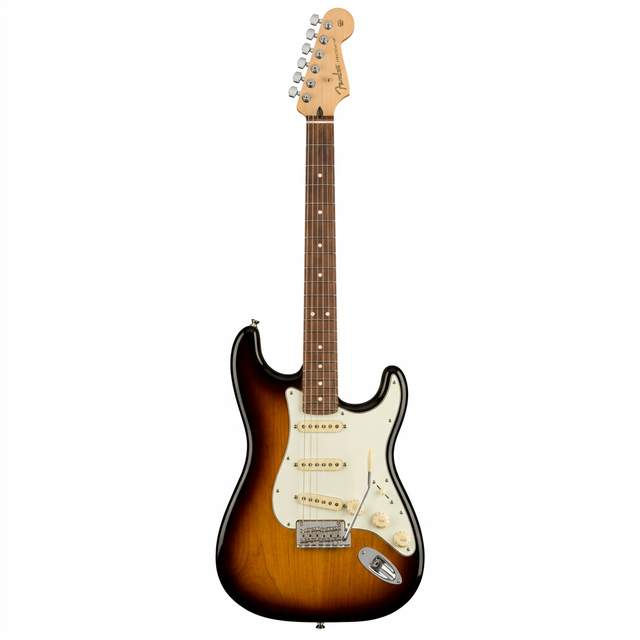
The Stratocaster uses three single-coil pickups with a 5-way selector switch, giving you five distinct voices:
- Bridge: Bright and thin, great for cutting leads
- Bridge + Middle (position 4): The famous “quack” tone, funky, glassy, perfect for Hendrix or Mayer
- Middle: Clean and balanced
- Middle + Neck (position 2): Another “quack” position, hazy, atmospheric
- Neck: Warm, round, buttery, ideal for blues and jazz
The Strat’s in-between positions (2 and 4) are genuinely unique sounds that no other guitar produces naturally. That “quack” is a defining Strat characteristic.
Tonal Comparison
| Characteristic | Telecaster | Stratocaster |
|---|---|---|
| Bridge tone | Bright, twangy, cutting | Bright, thin, piercing |
| Neck tone | Warm, dark, covered | Warm, bell-like, open |
| In-between tones | N/A | 2 unique “quack” positions |
| Best for | Country, indie, rock, blues | Blues, funk, rock, pop, jazz |
| Volume controls | 1 volume, 1 tone | 1 volume, 2 tone |
The Tremolo Question
The Stratocaster includes a synchronized tremolo bridge (whammy bar) that lets you bend notes and chords, add vibrato, and create dive-bomb effects. The Telecaster has a fixed bridge, no tremolo, but this means:
- Better tuning stability on the Tele
- Slightly more sustain on the Tele (debatable)
- No whammy bar fun on the Tele
If you want to do Hendrix-style whammy work or subtle Gilmour vibrato, you need a Strat. If you value absolute tuning stability and a simplified setup, the Tele wins here.
Neck & Playability
Both guitars share the same 25.5-inch scale length and typically the same 9.5-inch fretboard radius on modern models. However:
- Telecaster headstock: Smaller and more compact
- Stratocaster headstock: Larger, with all tuners on one side
- Telecaster neck heel: Square joint, can feel bulky at high frets
- Stratocaster neck heel: Rounded for smoother access
Both guitars typically feature 22 frets and offer maple or rosewood fingerboard options.
Famous Players
| Player | Guitar | Genre |
|---|---|---|
| Jimi Hendrix | Stratocaster | Rock/Blues |
| David Gilmour | Stratocaster | Progressive Rock |
| John Mayer | Stratocaster | Blues/Pop |
| Eric Clapton | Stratocaster | Blues |
| Mark Knopfler | Stratocaster | Rock |
| Keith Richards | Telecaster | Rock |
| Bruce Springsteen | Telecaster | Rock |
| Brad Paisley | Telecaster | Country |
| Joe Strummer | Telecaster | Punk |
| Jim Root | Telecaster | Metal |
2026 Price Comparison
| Model | Street Price | Notable Features |
|---|---|---|
| Squier Affinity Strat | ~$250 | Budget entry, poplar body |
| Squier Affinity Tele | ~$250 | Budget entry, poplar body |
| Fender Player II Strat | ~$850 | Alder body, new pickups |
| Fender Player II Tele | ~$850 | Alder body, new pickups |
| Fender American Pro II Strat | ~$1,700 | V-Mod II pickups, Deep C neck |
| Fender American Pro II Tele | ~$1,700 | V-Mod II pickups, Deep C neck |
Our Verdict
Choose the Telecaster if:
- You play country, indie rock, or punk
- You want simplicity (2 pickups, 1 tone knob, fixed bridge)
- You value tuning stability over whammy bar tricks
- You love that unmistakable twang
Choose the Stratocaster if:
- You play blues, funk, pop, or jazz
- You want maximum versatility (5 pickup positions)
- Comfort matters (contoured body, lighter weight)
- You want a tremolo bar
Can’t decide? The Stratocaster is the safer bet for most players. Its 5 tonal options cover more ground, and its ergonomics are genuinely superior. But if that Telecaster twang speaks to you, trust your ears. Both guitars have defined the sound of modern music.
Related articles: Fender vs Gibson: Which Brand Is Right for You?, Best Electric Guitars for Every Budget, Guitar Pedals Explained

Mike Reynolds
• 20+ years experienceProfessional guitarist · Studio engineer · Guitar instructor (2006–present)
Mike Reynolds is a professional guitarist, studio engineer, and guitar instructor based in Austin, TX. He has recorded with regional acts across rock, blues, and country, and has been teaching private guitar lessons since 2006. Mike built his first home studio in 2008 and has since helped hundreds of students find the right gear for their budget and goals.