How to Change Guitar Strings: The Complete Guide (2026)
Step-by-step guide to changing acoustic and electric guitar strings with photos. Learn when to change, which strings to buy, and pro tips for staying in tune.
Mike Reynolds
Professional Guitarist & Audio Engineer · 20+ years
ℹ️ Affiliate Disclosure: Music Gear Specialist earns from qualifying purchases through Amazon and other partner links. This doesn't affect our recommendations—we only suggest gear we'd use ourselves.
ℹ️ Affiliate Disclosure: Music Gear Specialist earns from qualifying purchases through Amazon and other partner links. This doesn't affect our recommendations—we only suggest gear we'd use ourselves.
TL;DR: Gather your tools (strings, wire cutters, winder, tuner), loosen the old strings, remove them, clean the fretboard, thread new strings through the bridge, wind them with 2-3 wraps per post, stretch them thoroughly, and retune. The whole process takes 15-20 minutes once you’ve done it a few times.
What You’ll Need
| Tool | Essential? | Why |
|---|---|---|
| New guitar strings | ✅ Yes | Obviously |
| Wire cutters/string cutters | ✅ Yes | Trim excess string length |
| String winder | Recommended | Speeds up winding 5x |
| Clip-on tuner | ✅ Yes | Accurate tuning after restringing |
| Soft cloth | Recommended | Fretboard cleaning |
| Fretboard oil/conditioner | Optional | Hydrates rosewood/ebony boards |
| Neck rest/guitar stand | Optional | Keeps guitar stable |
Cost: A basic string winder with built-in cutter runs $5-$10 at any music store. It’s the best $5 you’ll spend, winding strings by hand takes forever.
Step 1: Loosen and Remove Old Strings
Turn each tuning peg counter-clockwise until the string is completely slack. Use your string winder to speed this up.
For electric guitars: Change one string at a time to maintain neck tension and keep the tremolo bridge seated. This is especially important for Floyd Rose and floating tremolo bridges.
For acoustic guitars: You can remove all strings at once, this is a great time to deep-clean the fretboard. The neck will not warp from briefly having no tension.
Once slack, cut the strings near the 12th fret with your wire cutters. This makes them easier to remove from both ends.
Remove from tuning posts: Unwind the cut string from the tuning peg and discard.
Remove from bridge:
- Acoustic: Push the bridge pin inward while gently pulling the string. The pin should pop out. If stuck, use a bridge pin puller (many string winders have one built in).
- Electric (string-through): Pull the string through the body from the front.
- Electric (tailpiece): Pull the string through the tailpiece from the back.
Step 2: Clean the Fretboard
With the strings off (or each string removed individually), wipe down the fretboard with a soft, dry cloth. For a deeper clean:
- Rosewood/ebony fretboards: Apply a small amount of fretboard oil or lemon oil. Let it soak for 2-3 minutes, then wipe off the excess. This prevents the wood from drying and cracking. Do this every 2-3 string changes.
- Maple fretboards: These are typically finished (sealed), just wipe with a dry cloth. Don’t use oil on finished maple.
Also clean around the frets, bridge, and pickups/soundhole. String funk accumulates everywhere.
Step 3: Thread New Strings
Acoustic Guitar
- Identify the correct string, strings are typically numbered 1 (thinnest) to 6 (thickest) or color-coded at the ball end.
- Insert the ball end into the bridge pin hole.
- Push the bridge pin in while gently pulling the string upward until the ball end seats firmly against the bridge plate.
- Pull string toward headstock and thread through the tuning post hole.
Electric Guitar
- Feed the string through the bridge (from the back on string-through bodies, or through the tailpiece).
- Pull string toward headstock and thread through the tuning post hole.
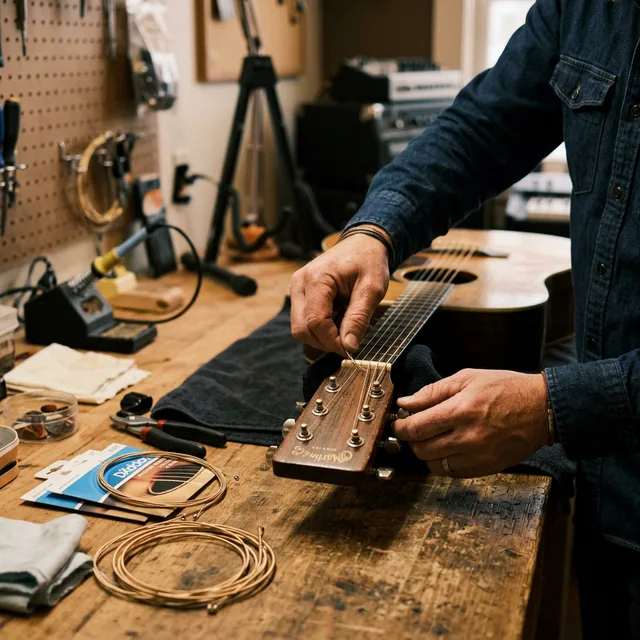
Step 4: Wind the Strings (The Key Step)
This is where most beginners go wrong. Proper winding = tuning stability.
The Correct Technique
-
Create slack: Pull the string taut, then add about 2-3 inches of slack past the tuning post. A common trick: pull the string to the next tuning post and measure one post’s worth of slack.
-
Thread through the post hole and bend the string 90 degrees at the exit point. This “kink” helps lock it in place.
-
Start winding: Turn the tuning peg so the string winds downward from the top of the post. The string should coil neatly below the exit hole.
-
First wrap: above the exit hole. This creates a “lock”, the string pinches itself in place.
-
Subsequent wraps: below the exit hole. Wind neatly downward.
How Many Wraps?
| String | Target Wraps | Why |
|---|---|---|
| Low E (6th) | 2-3 | Thick strings need fewer wraps |
| A (5th) | 2-3 | Same as low E |
| D (4th) | 3 | Transition thickness |
| G (3rd) | 3-4 | Thinner, needs more wrap angle |
| B (2nd) | 3-4 | Getting thinner |
| High E (1st) | 4-5 | Thinnest string, most wraps for grip |
Common Winding Mistakes
❌ Too many wraps: Creates a messy bird’s nest that can slip and bind, causing tuning issues.
❌ Too few wraps: The string may slip off the post or not grip firmly, causing rapid detuning.
❌ Wraps overlapping: Causes the string to bind on itself and slip unpredictably. Keep each wrap neatly below the previous one.
Step 5: Rough Tune
Bring all strings up to approximate pitch. Tune gradually, do not bring one string to perfect pitch before touching the others. The changing tension affects the neck relief, which affects all other strings.
Work through the strings several times, getting closer to pitch each pass.
Step 6: Stretch the Strings (Don’t Skip This!)
This is the step most beginners skip, and then they wonder why their new strings will not stay in tune.
Technique: For each string:
- Fret the string at the 1st fret with one hand.
- With your other hand, grab the string at the 12th fret and gently pull it away from the fretboard about an inch.
- Move your pulling hand along the string from bridge to nut, gently lifting and stretching.
- Retune and repeat 3-4 times per string until pulling no longer drops the pitch.
How hard to pull: Gentle but firm. You should feel the string give slightly. Never yank hard enough that you are worried about breaking the string.
Step 7: Final Tune and Trim
Once the strings hold pitch after stretching:
- Fine-tune with your tuner to exact pitch.
- Trim excess string protruding from the tuning posts with wire cutters. Leave about 1/4 inch, enough that the string end does not scratch you but short enough to look tidy.
- Play a few chords and check intonation. If notes sound out of tune at higher frets, your guitar may need an intonation adjustment (a separate topic).
Pro Tips
- Wash your hands before playing. Sweat and oils are the #1 string killer. Even 30 seconds of hand-washing extends string life significantly.
- Wipe strings after playing. A quick pass with a dry cloth removes sweat and grime, adding days to string life.
- Keep extra strings. Strings break at the worst times, always have a spare set in your case.
- Old strings recycle. D’Addario offers a Playback recycling program for used strings.
- String changing gets fast. Your first time may take 30-45 minutes. By your 10th time, you’ll do it in 10-15 minutes without thinking.
Troubleshooting
| Problem | Likely Cause | Fix |
|---|---|---|
| String slipping off post | Not enough wraps | Rewind with proper wrap count |
| String buzzing after change | String not seated in nut slot | Gently press string into nut groove |
| Won’t hold tune | Didn’t stretch strings properly | Stretch again, 3-4 pulls per string |
| Bridge pin keeps popping out (acoustic) | Ball end not seated | Push pin while pulling string taut |
| String broke during winding | Over-tightened or kinked | New string, wind more gently |
Related articles: Best Guitar Strings for Every Style, How to Read Guitar Tabs, Best Electric Guitars for Every Budget
See also: How to Set Up Your Guitar, Best Guitar Strings, Best Acoustic Guitars for Beginners

Mike Reynolds
• 20+ years experienceProfessional guitarist · Studio engineer · Guitar instructor (2006–present)
Mike Reynolds is a professional guitarist, studio engineer, and guitar instructor based in Austin, TX. He has recorded with regional acts across rock, blues, and country, and has been teaching private guitar lessons since 2006. Mike built his first home studio in 2008 and has since helped hundreds of students find the right gear for their budget and goals.