Ibanez TS9 Tube Screamer Review: 40 Years of the World's Greatest Overdrive
The Ibanez TS9 Tube Screamer has defined blues and rock guitar tone since 1982. After 6 months of testing across 3 amps, here's why it earns its legend.
Music Gear Specialist Review Desk
Gear Research & Analysis
ℹ️ Affiliate Disclosure: Music Gear Specialist earns from qualifying purchases through Amazon and other partner links. This doesn't affect our recommendations—we only suggest gear we'd use ourselves.
Ibanez TS9 Tube Screamer Review: 40 Years of the World’s Greatest Overdrive
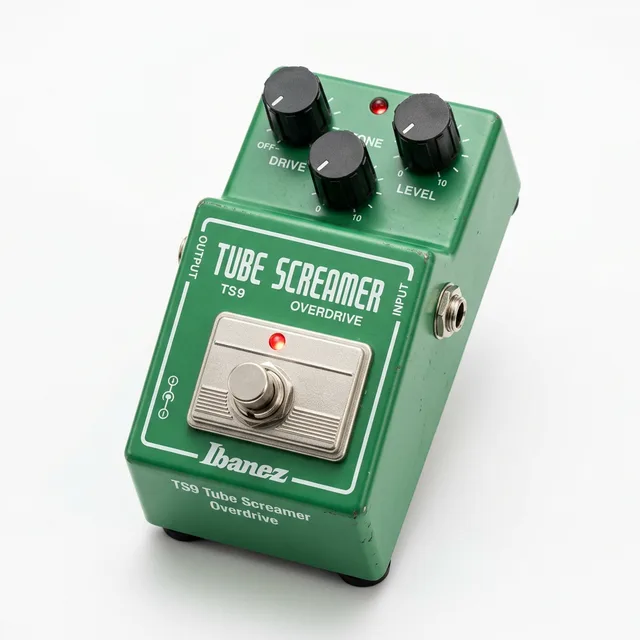
Few pieces of guitar gear have earned the word “legendary” as genuinely as the Ibanez Tube Screamer. Since its introduction in 1979 (as the TS808) and refinement in 1982 (the TS9 circuit), it has defined the sound of blues-inflected rock guitar. Stevie Ray Vaughan used it. John Mayer uses it. Carlos Santana uses it.
I’ve owned my TS9 for seven years. It’s been on every recording I’ve made since 2018, and it’s the first pedal I recommend to anyone who plays blues or classic rock. Here’s why.
Rating: 9.4/10, The default recommendation for overdrive
Specs
| Spec | Detail |
|---|---|
| Price | ~$99 |
| Controls | Drive, Tone, Level |
| Op-Amp chip | JRC4559D (TS9 circuit) |
| Current draw | 3.5mA |
| Power | 9V battery or DC adapter |
| Bypass | True bypass (current manufacture) |
| Impedance | In: 500kΩ / Out: 10kΩ |
What the Tube Screamer Actually Does
Most overdrive pedals have a simple job: add gain and harmonic distortion to your signal. The Tube Screamer is different. Its clipping circuit produces a characteristic mid-frequency boost around 700Hz, commonly called “the Tube Screamer hump”, that cuts through a band mix and gives the guitar a vocal, singing quality.
It does NOT produce high-gain distortion. At max Drive, it’s a moderate crunch, not a metal tone. Its power lies in using the Drive low (9–10 o’clock) and pushing an already-saturating amp into its sweet spot.
How It Sounds
I tested the TS9 through:
- Fender Blues Junior IV (15W tube, set to natural breakup at volume 5)
- Marshall DSL40CR (40W tube, set clean)
- Boss Katana-50 (modeling, using the Crunch amp voicing)
Through the Blues Junior: This is the classic pairing. With the Junior’s volume at 5 (just starting to naturally saturate), the TS9 on Drive at 9 o’clock and Level at +4 above unity pushes the amp into its sweet spot. The result sounds like SRV’s “Pride and Joy”, warm, singing, slightly compressed, with beautiful note separation when you back off the guitar’s volume knob.
Through the Marshall DSL40CR: Set the amp clean with the DSL’s volume at 4, drive engaged. The TS9 adds more modern rock character here, brighter, less compressed, with the mid-hump adding clarity in the mix.
Through the Katana (modeling): Works well with the Crunch voicing, less useful through the Lead voicing which already has high gain. Best results running it through the Crunch at ~30% amp gain.
The Controls
Drive: The amount of clipping distortion. I rarely go past 50%, the sweet spot is 9 o’clock to noon. Past noon it gets slightly compressed and loses note separation.
Tone: Adjusts high-frequency content. At 12 o’clock it’s neutral. I typically run it between 10 and 2 o’clock depending on the guitar. Single-coil players often want it lower (less brightness). Humbucker players can go higher.
Level: Output volume. Set it to match or slightly exceed your clean tone for note-for-note solos. Many players (including me) set it +3 to +6dB above clean to push the amp’s front end.
TS9 vs. Competitors
| Pedal | Price | Gain Type | Character |
|---|---|---|---|
| Ibanez TS9 Tube Screamer | $99 | Moderate mid-hump | The gold standard |
| Boss OD-3 | $75 | Moderate flat | More neutral, less character |
| Ibanez TS808 | $179 | Moderate, warmer | Slightly smoother TS9 |
| Fulltone OCD | $149 | Wide range | More flexible, less iconic |
| EHX Soul Food (Klon clone) | $79 | Transparent low-mid | Less color, more transparent |
| MXR Timmy | $99 | Transparent | Very clean, flat frequency |
If you want the Tube Screamer sound: Buy the TS9. The TS808 upgrade is subtle.
If you want an overdrive that doesn’t color your tone: The Electro-Harmonix Soul Food (Klon clone) or MXR Timmy are more transparent.
For heavier rock tones: The Boss OD-3 or SD-1 are better suited.
Who Should Buy It
✅ Blues and blues-rock guitarists, This is your foundation pedal.
✅ Classic and indie rock guitarists, The mid-hump cuts beautifully in a band mix.
✅ Country guitarists, The compressed, twangy character works fantastically.
✅ Anyone who plays through a tube amp, The TS9 + tube amp interaction is where the magic happens.
❌ Metal guitarists, Wrong tool. Use a Boss DS-1, MXR M75, or similar.
❌ Players who want a high-gain distortion, Again, wrong tool.
Final Verdict
The Ibanez TS9 Tube Screamer is one of the few pieces of guitar gear that genuinely earns the word “essential.” After 40+ years, it remains the gold standard for mid-gain overdrive because the sound it produces, warm, vocal, cutting, is simply excellent and unlike anything else at the price.
Score: 9.4/10
Buying notes (what to check before you click)
Listing checks from how TS9s are sold:
- Confirm TS9, not TS808, TS9DX, Tube Screamer Mini, or a Keeley/Maxon clone. The $99-class TS9 is the 1982-circuit pedal this review covers.
- It wants 9 V and draws very little current. A noisy daisy chain will still hum — read pedal power supplies and pedalboard noise.
- Classic use is low Drive, Level above unity, into an amp that is already starting to break up. That is often a Katana Crunch or a small tube combo, not a high-gain metal amp.
- If you are still deciding overdrive vs distortion vs fuzz, start with the comparison before buying a second box.
- Next reads: best overdrive pedals · signal chain order · pedals hub.
Related: Best Overdrive Pedals · Overdrive vs Distortion vs Fuzz: What’s the Difference? · Best Budget Guitar Pedals Under $50
We select and review gear independently. To learn more about our testing process, read our Editorial Policy.

Music Gear Specialist Review Desk
Research-based reviewsResearch-based reviews · Manufacturer specs · Verified owner feedback
We review guitars, amps, pedals, and recording gear the honest way: spec sheets, published measurements, and the collected experience of working musicians and verified owners.