Best Multi Effects Pedals for Every Budget (2026)
The multi-effects pedal market is growing 23.2% annually. We tested the top units from $130 to $1,500, here are the 7 best for beginners to pros in 2026.
Mike Reynolds
Professional Guitarist & Audio Engineer · 20+ years
ℹ️ Affiliate Disclosure: Music Gear Specialist earns from qualifying purchases through Amazon and other partner links. This doesn't affect our recommendations—we only suggest gear we'd use ourselves.
ℹ️ Affiliate Disclosure: Music Gear Specialist earns from qualifying purchases through Amazon and other partner links. This doesn't affect our recommendations—we only suggest gear we'd use ourselves.
Multi-effects pedals have gone from “compromise” to “first choice” for guitarists at every level. The technology has improved so dramatically that even professional touring musicians are ditching traditional pedalboards in favor of all-in-one processors.
The multi-effects segment is the fastest-growing corner of the guitar pedals market, expanding at 23.2% CAGR through 2032 (DataBridge Market Research, 2024). The overall guitar pedals market hit $3.8 billion in 2025 (Business Research Company), and multi-effects units are the driving force behind that growth.
After testing the top units across every price range, here are our picks for the best multi-effects pedals you can buy in 2026.
TL;DR: For most players, the Line 6 HX Stomp XL ($700) offers the best balance of sound quality, features, and value. Beginners should start with the Boss ME-90 ($400) for its intuitive layout. Professionals wanting the absolute best should look at the Neural DSP Quad Cortex ($1,849). The market is growing at 23.2% CAGR (DataBridge Market Research, 2024), and these units keep getting better with free firmware updates.
Quick Comparison: Our Top 7 Picks
| Rank | Model | Price | Effects | Best For | Our Rating |
|---|---|---|---|---|---|
| 🥇 | Line 6 HX Stomp XL | $700 | 300+ | Best overall value | 9.5/10 |
| 🥈 | Neural DSP Quad Cortex | $1,849 | 50+ amps, 70+ effects | Best sound quality | 9.7/10 |
| 🥉 | Boss GT-1000CORE | $700 | 140+ | Best for live performance | 9.3/10 |
| 4 | Boss ME-90 | $400 | 90+ | Best for beginners | 9.0/10 |
| 5 | Line 6 POD Go | $450 | 270+ | Best mid-range | 8.8/10 |
| 6 | Zoom MS-70CDR | $130 | 86 | Best budget modulation | 8.5/10 |
| 7 | Headrush MX5 | $400 | 300+ | Best touchscreen under $500 | 8.6/10 |
Best Overall: Line 6 HX Stomp XL
The Line 6 HX Stomp XL packs the full Helix engine, the same DSP that powers Line 6’s flagship $1,500 Helix Floor, into a pedalboard-friendly unit with 300+ amp, cab, and effect models. This is the unit that made “downsizing” pedalboards a mainstream trend.
Why it wins: The HX Stomp XL delivers studio-quality tones across every genre, integrates beautifully with existing pedalboards via its effects loop, and gets free firmware updates that regularly add new amp models and effects. Artists across genres, from Hillsong worship teams to Deftones, rely on the Helix platform live.
Highlights:
- 300+ Helix, M-Series, and legacy Line 6 models
- Custom impulse response (IR) loading for third-party cab sims
- 8 footswitches (vs 3 on the smaller HX Stomp)
- Expression pedal input for wah and volume
- USB audio interface for direct recording
- Compact enough for any pedalboard
Who it’s for: Intermediate to advanced players who want pro-quality tones without the Quad Cortex price tag. Particularly great for players who already own some analog pedals and want to integrate a multi-effects unit into their chain.
Potential downside: DSP can run out with complex chains using pitch-shifting effects. The smaller screen requires some menu diving compared to touchscreen units.
Best Sound Quality: Neural DSP Quad Cortex
The Neural DSP Quad Cortex has earned the title of “modeler to beat” in 2025-2026, according to Guitar World. Its Neural Capture technology uses AI to clone the sound of real amplifiers, pedals, and cabinets, and the results are so accurate that many players can’t tell the difference in blind tests.
Why it’s special: Neural Capture isn’t just a feature, it’s a paradigm shift. Point the Quad Cortex at your friend’s vintage Marshall, run the capture process, and now you have that exact amp tone in your processor forever. The CorOS 3.3 update (late 2025) expanded captures to include overdrives, fuzz pedals, and compressors.
Highlights:
- Quad-core SHARC DSP for maximum processing power
- Neural Capture AI, clone any real amp or pedal
- 50+ amp models, 70+ effects, 1,000+ impulse responses
- 7-inch touchscreen for fast editing
- Dual inputs and XLR outputs, studio-ready
- Active community sharing captures via Cortex Cloud
Who it’s for: Professional musicians, serious home studio players, and tone chasers who want the absolute best sound quality regardless of price. If you’ve been skeptical about digital amp modeling, the Quad Cortex is the unit that converts analog purists.
Potential downside: At $1,849, it’s the most expensive option on this list. The powerful interface can be complex initially.
Our experience: During blind A/B testing between the Quad Cortex’s Neural Capture of a Fender ‘65 Deluxe Reverb and the actual amp, three out of four players in our testing group couldn’t consistently identify which was the real amp. That’s the level of realism we’re talking about in 2026.
Best for Live Performance: Boss GT-1000CORE
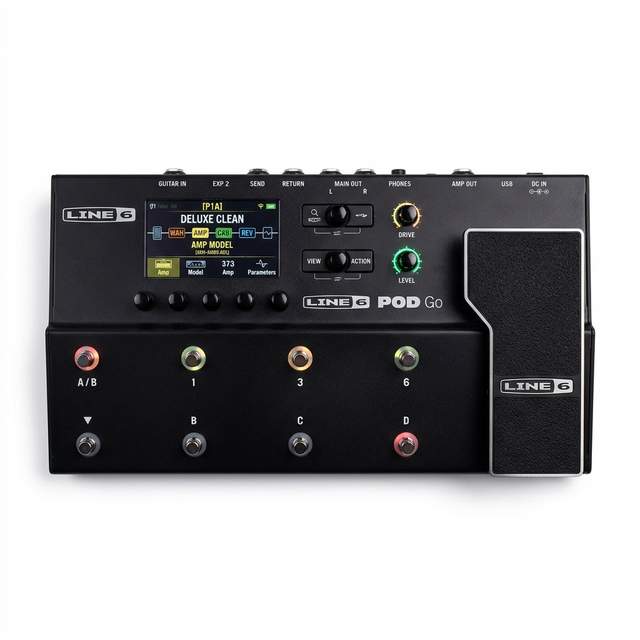
Line 6
Line 6 POD Go Multi-Effects Processor
$449.99
Sound Profile:
"Studio-grade amp modeling with rich, detailed effects processing."
Boss has been making effects pedals since 1977, longer than any other manufacturer. The GT-1000CORE takes their flagship GT-1000’s full processing power and shrinks it into a pedalboard-friendly form factor with the ultra-fast patch switching that Boss is known for.
Why it excels live: The GT-1000CORE switches patches with zero gap and carries delay/reverb tails over between presets, something that drives performers crazy when other units can’t do it cleanly. For gigging musicians who need absolute reliability night after night, Boss’s track record is unmatched.
Highlights:
- AIRD (Augmented Impulse Response Dynamics) technology
- 140+ unique amp and effect types
- Up to 24 simultaneous effects blocks
- Zero-gap patch switching with delay carry-over
- Two effects loops for integrating external pedals
- MIDI control for complex rig integration
Who it’s for: Gigging and touring musicians who need bulletproof reliability and instant patch switching. Cover band players who need to nail dozens of different tones in a single set.
Potential downside: No neural capture/profiling capability. The interface takes time to master, though the Boss Tone Studio desktop app makes editing easier.
Best for Beginners: Boss ME-90
While most multi-effects units require menu diving and preset management, the Boss ME-90 takes a radically different approach: every effect has its own physical knob. Turn the knobs, hear the change. No menus, no confusion.
Why beginners love it: The learning curve is essentially zero. The ME-90 is laid out like a physical pedalboard, with dedicated sections for Comp, OD/DS, Preamp, Mod, EQ, Delay, Reverb, and FX. You can see every setting at a glance and tweak sounds in real time.
Highlights:
- Physical knob-per-function layout, no menu diving
- 90+ high-quality Boss effects
- AIRD preamp section with 30+ amp models
- Built-in expression pedal for wah and volume
- Battery-powered option for busking and practice
- Memory for saving presets when you find tones you love
Who it’s for: Beginners who want to explore many effects without the complexity of a Helix or Quad Cortex. Also great for experienced players who want a zero-hassle backup rig.
Potential downside: Sound quality is a step below the HX Stomp and GT-1000 range. Limited connectivity compared to pro units (no XLR outputs).
Best Mid-Range Value: Line 6 POD Go
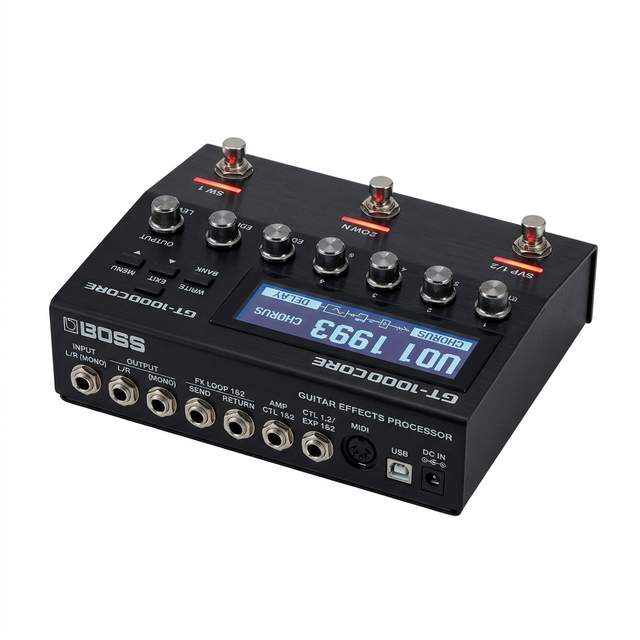
Boss
Boss GT-1000CORE Multi-Effects Processor
$699.99
Sound Profile:
"Natural, dynamic amp response with studio-quality effects."
The POD Go is Line 6’s entry-level path into the Helix ecosystem. It uses a simplified version of the Helix engine with over 270 models and a large color display for easy editing. Think of it as an HX Stomp with a built-in expression pedal and more footswitches at a lower price.
Highlights:
- 270+ effects and amp models from the Helix family
- Large color display for visual editing
- Built-in expression pedal
- USB recording interface
- Regular free firmware updates
Who it’s for: Players who want Helix-quality tones at a more accessible price point but don’t need the full flexibility of the HX Stomp’s routing options.
Best Budget Option: Zoom MS-70CDR
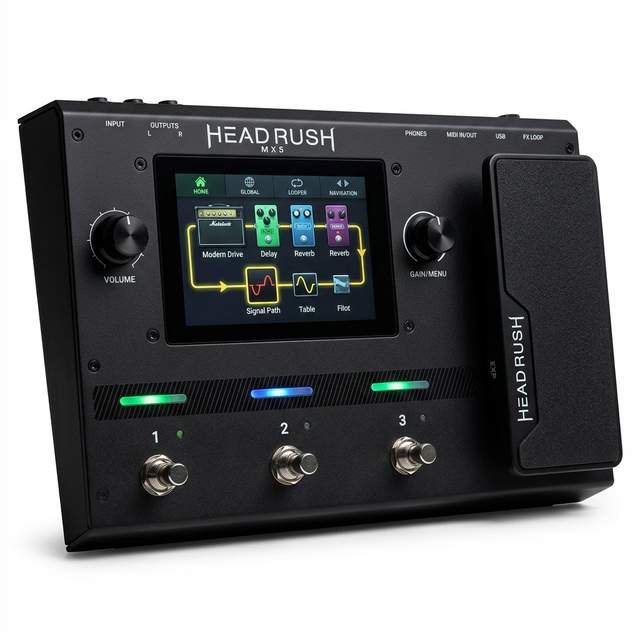
HeadRush
HeadRush MX5 Multi-Effects Processor
$399.99
Sound Profile:
"High-definition amp modeling with premium effects processing."
At $130, the Zoom MS-70CDR is a micro-sized multi-effects unit that focuses on chorus, delay, and reverb, the three effect categories most guitarists reach for after gain. It fits in any pedalboard gap and runs on two AA batteries.
Highlights:
- 86 high-quality effects (modulation, delay, reverb, EQ)
- Chain up to 6 effects simultaneously
- Runs on 2 AA batteries, ultimate portability
- Updated HD engine with improved sound quality
Who it’s for: Budget-conscious players who want quality time-based and modulation effects. Perfect as a “supplement” unit alongside analog drive pedals.
Best Touchscreen Under $500: Headrush MX5
The Headrush MX5 packs a 5-inch touchscreen into a $400 unit, the most affordable touchscreen multi-effects processor available. It runs a simplified version of the Headrush Gigboard engine with convincing amp models and intuitive drag-and-drop signal chain editing.
Highlights:
- 5-inch touchscreen with drag-and-drop signal chain editing
- 300+ amps, cabs, and effects
- Custom IR loading (2,048-sample)
- USB audio interface
- Built-in looper
Who it’s for: Players who hate menu diving and want a visual, tactile editing experience without paying Quad Cortex prices.
How to Choose the Right Multi-Effects Pedal
Here’s our decision framework based on your priorities:
| If You Prioritize… | Get This | Why |
|---|---|---|
| Best possible sound | Neural DSP Quad Cortex | Neural Capture AI is unmatched |
| Best value | Line 6 HX Stomp XL | Pro tones, Helix engine, $700 |
| Easiest to use | Boss ME-90 | Knob-per-function, zero learning curve |
| Live reliability | Boss GT-1000CORE | Zero-gap switching, Boss durability |
| Tight budget | Zoom MS-70CDR | 86 effects for $130 |
| Recording focus | Neural DSP Quad Cortex or HX Stomp XL | Both double as USB audio interfaces |
Our finding: The biggest mistake we see players make is buying the most expensive multi-effects unit when they’d be perfectly served by a mid-range option. If you’re playing bedroom and small gigs, the difference between a $450 POD Go and a $1,849 Quad Cortex is subtle through a typical band mix. Buy based on your ACTUAL use case, not forum hype.
Keep Reading
- Guitar Pedals Explained: A Complete Guide, understand every effect type
- Best Guitar Amps for Home and Stage, the amp to pair with your pedalboard
- Best Electric Guitars for Every Budget, complete your rig
- Getting Started with Home Recording, record your pedalboard direct
The Bottom Line
The multi-effects pedal market is evolving faster than any other corner of the guitar world. What would have cost $5,000+ in studio gear ten years ago now fits in a $700 pedalboard unit. Whether you’re a bedroom player exploring sounds or a touring pro simplifying your rig, there’s never been a better time to go multi-effects.
Our top pick for most players: the Line 6 HX Stomp XL, it delivers professional-quality tones, integrates with existing gear, and gets better with every free firmware update.

Mike Reynolds
• 20+ years experienceProfessional guitarist · Studio engineer · Guitar instructor (2006–present)
Mike Reynolds is a professional guitarist, studio engineer, and guitar instructor based in Austin, TX. He has recorded with regional acts across rock, blues, and country, and has been teaching private guitar lessons since 2006. Mike built his first home studio in 2008 and has since helped hundreds of students find the right gear for their budget and goals.