Audio-Technica ATH-M50x Review: Honest Specs, Sound, and Verdict
Research-based ATH-M50x review: real Audio-Technica specs, owner and reviewer consensus on sound, comfort, and an honest verdict for home studio use.
Music Gear Specialist Review Desk
Gear Research & Analysis
ℹ️ Affiliate Disclosure: Music Gear Specialist earns from qualifying purchases through Amazon and other partner links. This doesn't affect our recommendations—we only suggest gear we'd use ourselves.
As an Amazon Associate we may earn a commission from qualifying purchases made through links on this page, at no extra cost to you.
The Audio-Technica ATH-M50x is one of those rare pieces of gear that has outlasted trends. More than a decade after it arrived as the successor to the long-running ATH-M50, it remains one of the most recommended closed-back studio headphones for home and project studios — and one of the most debated. Some owners call it the best value headphone under $200; others argue its sound is too colored for serious mixing.
This is a research-based review, not the result of first-hand lab testing. It synthesizes Audio-Technica’s published specifications with the recurring themes in verified owner reviews and professional write-ups, to give you an honest picture of what the ATH-M50x does well, where it falls short, and who it actually suits.
You can check the current price of the ATH-M50x on Amazon, or read on for the full breakdown.
What the ATH-M50x Is (and Who It’s Built For)
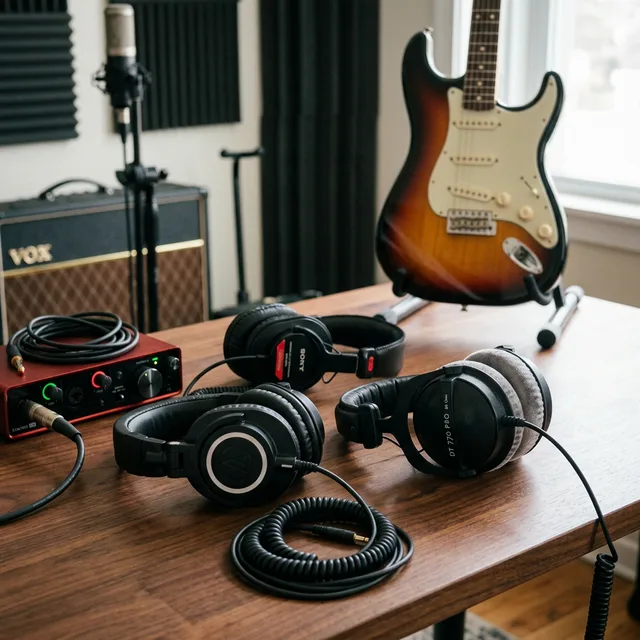
The ATH-M50x is a closed-back, over-ear (circumaural) dynamic headphone designed for studio monitoring, tracking, and DJ use. “Closed-back” means the outer side of the earcup is sealed rather than open-grille — and the practical payoff is isolation. Leakage is reduced in both directions: less of your mix bleeds out, and less room noise bleeds in. That matters most when you’re recording, because headphone bleed into a microphone is one of the most common tracking headaches. If you’ve fought that problem, the broader signal chain is covered in our guide to home studio recording essentials.
In plain terms, the M50x is built for:
- Tracking musicians — guitarists, bassists, vocalists, and podcasters who need to monitor themselves without leaking into the mic.
- DJs and live performers — the earcups swivel and fold, and the isolation plus energetic low end suit booth use.
- Home and project studio owners — a first “real” pair of headphones for rough mixes, editing, and content production.
- Everyday listeners who want one durable headphone that also happens to handle production work.
It is not, on its own, the most neutral reference headphone on the market — more on that below.
The Specs That Matter
Here are the ATH-M50x’s published specifications, drawn from Audio-Technica’s official product page:
- Driver size: 45 mm
- Type: Closed-back dynamic, circumaural
- Frequency response: 15 Hz – 28,000 Hz
- Maximum input power: 1,600 mW
- Sensitivity: 99 dB/mW
- Impedance: 38 Ω
- Weight: 285 g (without cable)
- Cables: Detachable — three included (1.2 m straight, 3 m straight, 1.2–3 m coiled)
- Connectors: Gold-plated 3.5 mm (1/8”) plug with a 6.3 mm (1/4”) adapter
Two of these numbers tell most of the story. The 38 Ω impedance paired with 99 dB/mW sensitivity means the M50x is efficient and easy to drive — you’ll get plenty of volume from a phone, a laptop headphone jack, or a budget audio interface, with no dedicated headphone amp required. (The general relationship between impedance, sensitivity, and how hard a headphone is to drive is well covered in Wikipedia’s overview of headphones.) The detachable cable is the single biggest practical upgrade over the older M50: three cables ship in the box, and since the cable is the part most likely to fail on any headphone, being able to swap it extends the usable life of the pair considerably.
How It Sounds: The Owner and Reviewer Consensus
Spec sheets don’t describe sound, and the M50x is a good example of why. Across verified owner reviews and professional write-ups, the consensus on its character is remarkably consistent.
Strengths people agree on:
- Punchy, extended low end. The bass is full and energetic — a big reason DJs and electronic producers gravitate toward it.
- Crisp, detailed highs. High-frequency detail is clear, which helps when editing audio and spotting problems in a recording.
- Strong isolation and a lively, engaging presentation that makes music sound “fun” rather than clinical.
The recurring gripes:
- It’s not a flat reference. The M50x has a slightly V-shaped tuning — boosted lows and highs relative to the midrange. Several experienced reviewers caution against using it as your only mixing tool, because a mix that sounds balanced on the M50x can come out thin or harsh on flatter systems. For critical mixing and mastering, a more neutral option from our roundup of the best studio headphones for mixing may serve you better.
- Listener fatigue. Some owners find the emphasized highs a little piercing over long sessions, and the firm clamping force doesn’t help comfort for everyone.
- Narrow soundstage. As with most closed-back designs, the sound sits “in your head” rather than around you — fine for tracking, less ideal if you want an open, airy presentation.
The short version: it’s an exciting, detailed, isolating headphone that leans colored rather than clinical. Whether that’s a feature or a flaw depends entirely on how you plan to use it.
Build, Comfort, and Daily Use
If there’s one area where the M50x earns near-universal praise, it’s build quality. The recurring owner themes:
- Road-worthy construction. A plastic-and-metal frame that folds down compactly; earcups swivel 90° and fold flat. It’s built to travel and survive a gig bag.
- Detachable, locking cables — three in the box, and the connectors are designed so left and right can’t be easily crossed, which keeps phasing correct.
- Serviceable. The earpads and cable are replaceable, so you’re not discarding the whole headphone when parts wear.
The comfort picture is more mixed. The clamping force is firm out of the box — which is precisely what gives the M50x its good passive isolation, but can feel tight for the first several wears and may fatigue listeners with larger heads or glasses. The stock vinyl earpads can also get warm during long sessions. Many owners swap in aftermarket pads (velour, for example) to improve comfort, though doing so can subtly change the sound signature. For a home-studio workflow that also involves speakers, the M50x pairs naturally with a budget monitoring setup — see our picks for studio monitors under $300 for the other half of that chain.
Where the M50x Fits: Versus the Alternatives
No headphone is right for everyone, and the M50x has well-known rivals in the same price band:
- Sony MDR-7506 — the other great studio “default.” Brighter and more mid-forward, lighter, foldable, and usually a touch cheaper, but with a non-detachable cable and a more utilitarian build.
- Beyerdynamic DT 770 Pro — closed-back, very comfortable, durable, with a similar V-shaped energy, but a fixed non-detachable cable and higher-impedance variants that benefit from a headphone amp.
- Audio-Technica ATH-M40x — the M50x’s sibling, generally described as flatter and slightly cheaper, making it a common pick for those who find the M50x too colored.
If you want isolation, energy, and durability for tracking, DJing, or content work, the M50x is a strong, safe choice. If your priority is a neutral mixing reference or a wide, open soundstage, those alternatives — or an open-back model — are worth the detour. For someone just assembling a first rig, our home recording setup guide walks through how a headphone like this fits alongside an audio interface and monitors. The usual interface is the Scarlett 2i2; small speakers are covered in the KRK Rokit 5 G4 review and studio monitors vs headphones.
Honest Verdict
The Audio-Technica ATH-M50x earned its reputation for a reason: it’s a durable, easy-to-drive, isolating headphone with an engaging sound and a genuinely useful detachable-cable system, all at a price that still makes sense. Its weaknesses are real but well-documented — a colored, V-shaped tuning that’s better suited to tracking and listening than to surgical mixing, a firm clamp, and a closed-back soundstage.
For tracking musicians, DJs, podcasters, and home-studio owners who want one dependable headphone for monitoring and everyday listening, it remains one of the best values in its category. For dedicated mixing and mastering, treat it as a secondary reference rather than your single source of truth.
Check the latest price of the ATH-M50x on Amazon →
Buying notes (what to check before you click)
Listing checks from how these get used at a desk, not invented measurements:
- Confirm ATH-M50x, not M50xBT / M50xSTS / M40x, if you want the wired studio pair with three detachable cables. Specs live on Audio-Technica’s ATH-M50x page.
- You do not need a headphone amp. A phone, laptop, or Scarlett-class interface will drive them.
- If you wear glasses or mix for hours, plan on aftermarket pads. The clamp is the comfort complaint owners repeat.
- Treat them as tracking and check-mix cans. For speaker decisions, read the KRK Rokit 5 G4 review instead of expecting the M50x to be a flat reference.
- Mic-side next reads: Shure SM57 review · Cloudlifter + Scarlett + SM7B · recording hub.
Quick Verdict
Rating: 4.3 / 5
The default closed-back for a reason: isolation, foldability, and a rugged build. The V-shaped tuning and firm clamp are real cons for long mixing sessions.
Frequently Asked Questions
Is the ATH-M50x good for mixing? It works for rough mixes and editing, but its V-shaped, colored sound means most experienced engineers wouldn’t use it as their only mixing reference. It shines more at tracking, DJing, and casual listening.
Do I need a headphone amp for the M50x? Generally, no. At 38 Ω and 99 dB/mW, it’s efficient enough to run comfortably from a phone, a laptop, or an audio interface.
Are the cables replaceable? Yes. The M50x ships with three detachable cables (1.2 m straight, 3 m straight, and a coiled cable), and replacement cables and earpads are widely available.
M50x or M40x? The M40x is typically described as flatter and slightly cheaper; the M50x offers more bass energy and detail but a more colored signature. Flatter mixing leans toward the M40x; punchy tracking and listening toward the M50x.
Open-back or closed-back? The M50x is closed-back, which provides isolation and minimizes mic bleed during tracking — its main job. Open-back headphones trade isolation for a wider soundstage and are usually preferred for critical mixing.

Music Gear Specialist Review Desk
Research-based reviewsResearch-based reviews · Manufacturer specs · Verified owner feedback
We review guitars, amps, pedals, and recording gear the honest way: spec sheets, published measurements, and the collected experience of working musicians and verified owners.