Best Studio Headphones for Mixing and Mastering
Stop mixing on Beats by Dre. We review the best flat-response, open-back studio headphones that reveal the absolute truth about your music production.
Music Gear Specialist Review Desk
Gear Research & Analysis
ℹ️ Affiliate Disclosure: Music Gear Specialist earns from qualifying purchases through Amazon and other partner links. This doesn't affect our recommendations—we only suggest gear we'd use ourselves.
The acoustics of the room you mix in dictate 50% of the final quality of your song. If your bedroom is an untreated cube of drywall, bass frequencies will bounce off the corners, creating “standing waves.” You will boost or cut frequencies in your mix to compensate for a problem that only exists in your room, permanently ruining the mix for everyone else.
If you cannot afford $2,000 in acoustic treatment panels, the only viable solution is to remove the room from the equation entirely by mixing on high-end studio headphones.
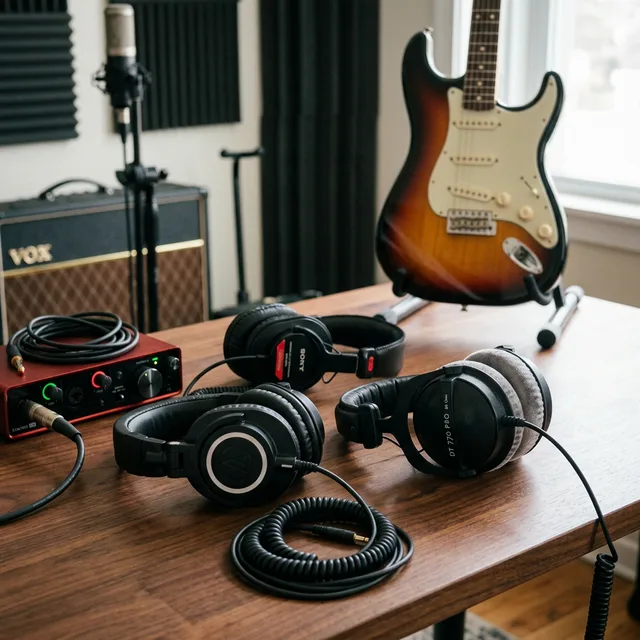
But you cannot mix on consumer headphones. You need clinically precise, painfully honest, “flat-response” studio headphones. Here are the best mixing headphones of 2026.
The Open-Back Superiority
For mixing and mastering, Open-Back headphones are mandatory.
When you put on closed-back headphones, the low audio frequencies bounce off the solid plastic shell and reflect back onto the driver, creating an artificial build-up of muddy bass inside the earcup. By having a mesh, open grill, open-back headphones allow the audio to project out into the room naturally.
This accomplishes two critical things:
- Accurate Low-End: The bass response is tight, controlled, and mathematically truthful because there is no artificial acoustic resonance inside the cup.
- The Soundstage: Open-backs sound incredibly wide. It feels like the audio is occurring in a physical room around your head, rather than being injected directly into your brain. This makes panning instruments Left and Right much more accurate.
(Note: Never use open-back headphones while recording vocals; the backing track will bleed out of the mesh grill and be recorded by your microphone).
Top Picks: The Truth Tellers
1. Beyerdynamic DT 990 Pro, Best Overall Value
The Beyerdynamic DT 990 Pro has been a staple in professional studios for decades, and its reign remains uncontested in 2026 for home producers. These open-back headphones offer arguably the most aggressive, microscopic detail of any headphone under $500.
Specs:
- Type: Open-Back
- Impedance: Available in 80 Ohm or 250 Ohm models
- Frequency Response: 5Hz to 35,000Hz
Pros: The comfort level is legendary thanks to the velour earpads; you can wear these for a 6-hour mixing session without fatigue. They emphasize high-end treble frequencies specifically designed to highlight harshness or sibilance (sharp ‘S’ sounds) in vocal tracks, forcing you to fix them. Cons: The coiled cable on the Pro version is heavy and non-detachable. The exaggerated treble response can be harsh if you are just casually listening to poorly mixed music.
2. Sennheiser HD 600, The Midrange King
If Beyerdynamic rules the high-end frequencies, the Sennheiser HD 600 rules the vital midrange. The midrange frequencies (between 500Hz and 4kHz) are where the human voice, the snare drum, and the electric guitars live. If your midrange is wrong, the mix is ruined.
Specs:
- Type: Open-Back
- Impedance: 300 Ohms
- Driver: Audiophile-grade dynamic drivers
Pros: The HD 600 is widely considered the most “natural” sounding headphone ever manufactured. Mixes completed on HD 600s translate flawlessly to car stereos and club PAs. All parts (pads, cables, headband) are easily replaceable. Cons: The high impedance (300 Ohm) means you absolutely must own a high-quality audio interface or external headphone amplifier to power them correctly. The clamping force on the skull is notoriously tight during the first month of ownership.
3. Audio-Technica ATH-M50x, Best Closed-Back Alternative
If you live in a noisy apartment, or share a bedroom with a roommate, open-back headphones are impossible to use because you hear every ambient noise in the room. If you must use closed-back headphones, the ATH-M50x is the industry standard.
Specs:
- Type: Closed-Back
- Impedance: 38 Ohms
- Swivel: 90-degree swiveling earcups
Pros: Incredible isolation from outside noise. Extremely punchy, defined bass response. Low impedance means they sound fantastic plugged directly into a laptop or smartphone without an amp. Cons: The soundstage feels very narrow and claustrophobic compared to open-backs. The bass is slightly artificially bumped, requiring you to learn how they sound before trusting them completely on a low-end heavy dance mix.
How to Mix on Headphones (And Not Go Crazy)
Mixing exclusively on headphones introduces one massive biological problem: the crossfeed deficit.
When you listen to studio monitors in a room, your right ear hears the right speaker, but it also hears a delayed, quieter version of the left speaker. When you wear headphones, your right ear definitively hears only the right channel. This hard isolation makes headphone mixes sound unnaturally wide, causing engineers to over-pan mix elements toward the center.
The Solution: Use crossfeed plugins. In 2026, software like Goodhertz CanOpener Studio or Waves Abbey Road Studio 3 are essential. You place these plugins on your Master bus within Logic or ProTools. They use psychoacoustic DSP modeling to subtly blend the left and right channels, tricking your brain into acting exactly as if you were sitting in a million-dollar mastering room listening to physical speakers.
Buying notes (what to check before you click)
Listing checks Amazon copy skips. Headphone street prices on this page are a research snapshot, not a live offer.
Use-case fit
- Mix / master translation, open-back, treble that shows sibilance: Beyerdynamic DT 990 Pro. Confirm ohm rating in the title: DT 990 Pro.
- Midrange you will trust on vocals and guitars: Sennheiser HD 600 (300 Ω — needs a real headphone amp).
- Noisy apartment, vocal tracking, or a roommate: closed-back ATH-M50x. Long write-up: Audio-Technica ATH-M50x review.
- Untreated bedroom that also needs speakers: do not replace a pair of studio monitors under $300 with cans forever. Cross-check: monitors vs headphones for mixing.
When to skip / when to buy
- Skip open-backs for vocal tracking. The mesh leaks the cue mix into the mic. That is a closed-back job — open-back vs closed-back.
- Skip 250 Ω / 300 Ω if the only amp is a laptop dongle. They will sound thin, not “accurate.”
- Skip Beats / AirPods as mix cans. The bass boost is the reason mixes disappear in a car.
- Buy the DT 990 Pro (80 Ω) if the interface headphone jack is the only amp. Buy HD 600 only after the Mac interface can drive them.
Listing checks the product title usually omits
- 80 Ohm vs 250 Ohm on the DT 990 Pro. Same cups, different voltage need. “Pro” is not the ohm rating.
- DT 990 vs DT 770 vs DT 880. 990 is open. 770 is closed. 880 is semi-open. Thumbnails look related.
- M50x vs M50xBT. Bluetooth is a commute SKU, not a mix clock.
- Coiled vs straight, detachable vs fixed. DT 990 Pro cable is typically fixed; HD 600 and M50x are replaceable.
- “Studio” in a consumer listing. Marketing word, not a flat curve.
A first beginner bass still needs a monitoring path if it is going DI. Wider headphone inventory: best studio headphones.
Next reads: recording hub · best music gear roundups.
Related Reading

Music Gear Specialist Review Desk
Research-based reviewsResearch-based reviews · Manufacturer specs · Verified owner feedback
We review guitars, amps, pedals, and recording gear the honest way: spec sheets, published measurements, and the collected experience of working musicians and verified owners.