Best Bass Guitars for Beginners (Stop Playing Lead)
The world has enough guitarists; we need bass players. Here are the best starter bass guitars that won't destroy your hands or your wallet.
Music Gear Specialist Review Desk
Gear Research & Analysis
ℹ️ Affiliate Disclosure: Music Gear Specialist earns from qualifying purchases through Amazon and other partner links. This doesn't affect our recommendations—we only suggest gear we'd use ourselves.
There is an old, deeply cynical joke in the music industry: If you want to be famous, play lead guitar. If you want a job, play bass.
Every town is overflowing with decent guitar players desperately searching for a rhythm section. A competent bass player who can hold a steady groove and lock in with a drum kick will never be out of gig work. But starting on bass requires specific hardware.
Because the strings are bridge cables under immense tension, a cheap, poorly constructed bass will warp, bow, and develop an “action” (string height) so absurdly high that it requires vice-grip strength to play a single note. Here are the best beginner bass guitars of 2026 that feature stable, playable necks.
The Two Titans: Precision vs. Jazz
Before you buy a bass, you must understand the two foundational shapes and tones that dominate 90% of popular music.
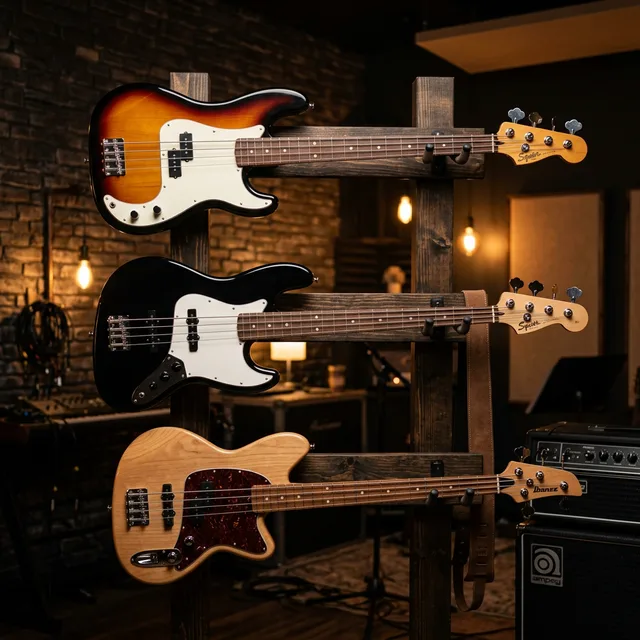
The Precision Bass (P-Bass): Invented by Leo Fender in 1951, this features a single “split-coil” pickup. It produces a massive, thick, “thumpy” tone that sits perfectly under the mix in Motown, classic rock, punk, and R&B. The neck near the nut is thick and chunky like a baseball bat.
The Jazz Bass (J-Bass): Released by Fender in 1960. It features two single-coil pickups, allowing for a brighter, more aggressive “growl” that cuts through the mix. It is heavily used in funk, progressive rock, and slap bass playing (think Flea from RHCP). The crucial difference for beginners: the J-Bass neck is extraordinarily thin and narrow at the nut, making it much easier for small hands to handle.
Top Beginner Bass Models
1. Squier Classic Vibe ’60s Jazz Bass — Best Overall
Squier is Fender’s budget brand, but the “Classic Vibe” tier is notoriously over-engineered. Many touring professionals use Classic Vibe basses on the road so their $2,000 American Fenders don’t get stolen.
Specs:
- Scale length: 34” (Standard/Long scale)
- Body: Poplar
- Neck profile: “C” Shape, ultra-slim 1.5” nut width
- Pickups: Dual Fender-Designed Alnico Single-Coils
Pros: The ultra-slim neck is the most forgiving entry point for smaller hands handling the long 34-inch scale. The dual pickups provide immense tonal variety. Build quality rivals standard Mexican-made Fenders. Cons: The two single-coil pickups can suffer from 60-cycle hum if you play sitting too close to an unshielded computer monitor or neon sign.
2. Yamaha TRBX174EW — Best Modern/Ergonomic Budget Choice
Yamaha simply refuses to make a bad instrument. While the Squier models cling strictly to 1960s vintage aesthetics, the Yamaha TRBX line uses modern, highly ergonomic body cuts that balance perfectly on the knee without diving forward.
Specs:
- Scale length: 34” (Standard)
- Body: Mahogany with Mango Wood top (Striking)
- Pickups: PJ Configuration (One P-Bass split coil, One J-Bass single coil)
Pros: The “PJ” pickup configuration is the holy grail of versatility. You can get the massive vintage thump of a P-Bass, then dial in the bridge pickup for modern J-Bass growl. Exceptionally lightweight and perfectly balanced. Visually gorgeous exotic wood tops rare at this price point. Cons: The fretwork is generally solid but occasional sharp fret ends require a setup from a local guitar tech to perfect the playability.
3. Ibanez GSRM20 Mikro — Best for Kids or Tiny Hands (Short Scale)
A standard bass has a 34-inch scale length. It is a massive weapon. For children under 12, or adults with exceptionally small hands, handling the distance between the first and third fret can cause literal wrist damage. The “Short Scale” bass solves this.
Specs:
- Scale Length: 28.6” (Extremely short)
- Body: Poplar
- Pickups: Dynamix PJ Configuration
Pros: Playing this is as easy as playing an electric guitar. The strings are under significantly less tension, making fretting effortless. The shorter distance between frets eliminates the need to aggressively stretch your pinky finger. Cons: Short-scale basses physically lack the massive resonant tension of a 34-inch drop. The low “E” string can sound a bit “flubby” and indistinct compared to a full-sized bass.
Active vs. Passive Electronics
As you browse the market, you will notice some basses advertise “Active EQs.”
Passive Basses (e.g., Squier Classic Vibe): No batteries required. They have standard volume and tone knobs that only “cut” treble frequencies. They sound vintage, warm, and highly dynamic.
Active Basses (e.g., modern Ibanez Soundgears): Require a 9-volt battery in the back. They feature an onboard preamp that can artificially “boost” bass, mid, and treble frequencies into extreme territories. This provides a highly compressed, massively loud, modern hi-fi sound ideal for modern metal or aggressive slap funk.
Advice for Beginners: Start with a passive bass. Active basses introduce an overwhelming amount of variables (a 3-band EQ in front of the amplifier’s 3-band EQ). Learn to get a good tone out of your fingers and a passive instrument first before relying on an internal computer to fix your sound. Also, beginners always forget to unplug their cables, killing the 9V battery overnight.
Buying notes (what to check before you click)
Listing checks Amazon copy skips. Street prices for these starter basses are a research snapshot, not a live offer — confirm the current listing before you click.
Use-case fit
- First bass, smaller hands, 34-inch scale: Classic Vibe ’60s Jazz (slim 1.5” nut). Search the exact series, not a random “Squier Jazz”: Squier Classic Vibe 60s Jazz Bass.
- Modern PJ versatility without vintage cosmetics: Yamaha TRBX174EW.
- Kids, short arms, or a first instrument that should feel like a guitar: Ibanez GSRM20 Mikro (28.6” scale). A “short scale” title that does not say Mikro is often a 30-inch bass, not this one.
- Punk / Motown thump on a P-Bass silhouette: that is a different neck. Compare the under-$500 bass list before you assume every Classic Vibe is a Jazz.
When to skip / when to buy
- Skip a 5-string as a first bass. The extra B is a mute-and-intone problem, not a shortcut to metal. High-gain 6-string context lives on electric guitars for metal.
- Skip a “bass starter pack” that ships a 10 W guitar combo. Bass will tear a guitar speaker. A dedicated bass amp, or a DI into a Mac audio interface, is the real second purchase.
- Skip active 3-band onboard EQ until a passive volume/tone stack makes sense. Battery drain on actives is covered in how to fix active pickup battery drain.
- Buy the Classic Vibe Jazz or TRBX174EW if the only question is “will a 34-inch neck be playable?” That is the honest first cart.
Listing checks the product title usually omits
- Classic Vibe vs Affinity vs Sonic. Same headstock logo, different fretwork and hardware. Photos hide the series badge.
- 4-string vs 5-string in the photo. A “Jazz Bass” search returns both.
- Scale length: 34” vs Mikro 28.6” vs generic “short scale” 30”. Confirm the spec block, not the lifestyle shot.
- Left-handed SKU. Many Classic Vibe finishes are right-only.
- Sold as a bass vs a pack. Toy amps and no-name cables are not a setup.
Wider beginner inventory (more models, Amazon dps) is on best bass guitars for beginners. Passive vs active electronics in general: active vs passive pickups. A capo is not a bass accessory — that page is best capos for acoustic and electric.
Next reads: guitars hub · best music gear roundups · under-$500 basses.
Related Reading

Music Gear Specialist Review Desk
Research-based reviewsResearch-based reviews · Manufacturer specs · Verified owner feedback
We review guitars, amps, pedals, and recording gear the honest way: spec sheets, published measurements, and the collected experience of working musicians and verified owners.