Epiphone Les Paul Standard '60s Review: A Bourbon Burst Beauty That Earns Its Keep
An honest review of the Epiphone Les Paul Standard '60s (Bourbon Burst): verified specs, ProBucker tone, owner consensus, and value vs Gibson USA.
Music Gear Specialist Review Desk
Gear Research & Analysis
ℹ️ Affiliate Disclosure: Music Gear Specialist earns from qualifying purchases through Amazon and other partner links. This doesn't affect our recommendations—we only suggest gear we'd use ourselves.
By Music Gear Specialist Review Desk — last updated August 1, 2026.
As an Amazon Associate we may earn a commission from qualifying purchases made through links on this page, at no extra cost to you.
Few guitars carry as much mythology as the Les Paul. For decades it has been the sound of rock, blues, jazz, and country lead work — a solid-mahogany body, a carved maple cap, and a pair of humbuckers that turn even a modest amp into something authoritative. The catch has always been price: a Gibson USA Les Paul Standard is a serious investment. That’s exactly the gap the Epiphone Les Paul Standard ’60s — in this case the Bourbon Burst finish — is built to fill.
This is a research-based review, not a hands-on lab test. What follows is a synthesis of Epiphone’s official specifications with the recurring themes in verified owner reviews and established guitar publications. Where we state a number, it’s a manufacturer spec or an attributed source — never an invented measurement.
The short version
The Epiphone Les Paul Standard ’60s is widely regarded as one of the strongest values in the “looks, feels, and sounds like the real thing” category. For roughly the price of a mid-tier solid-state amp, you get a mahogany-and-maple Les Paul with proper humbuckers, push/pull coil-splitting, and the kind of finish that photographs like a guitar costing several times more. Its weak spots are the weak spots of every Les Paul: weight and a neck joint that demands good factory setup. On balance, the consensus is that it punches well above its price.
Who the Epiphone Les Paul Standard ’60s is for
This is a guitar for players who want classic humbucker Les Paul tone without paying Gibson USA money. That covers a lot of people:
- Intermediate players upgrading from a starter instrument who want a “forever” guitar that won’t be outgrown quickly.
- Gigging musicians who need a reliable, great-sounding workhorse but don’t want to tour with a $3,000+ instrument.
- Home and studio recordists chasing that thick, sustain-rich Les Paul character for rock, blues, fusion, and indie tracking.
- Tone traditionalists who specifically want a 24.75”-scale, mahogany-neck platform rather than a 25.5”-scale bolt-on. (If you’re still deciding which philosophy suits you, our Fender vs Gibson breakdown covers the design trade-offs in depth.)
It’s not the best pick if you play a lot of modern shred or sweep picking and want a thin, fast, compound-radius neck — the Les Paul platform favors feel and sustain over ergonomic speed. And if your budget is strictly under $300, you’re in a different segment; see our best beginner electric guitar under $300 round-up instead.
Build & key specs at a glance
Per Epiphone’s official product specifications, the Standard ’60s is built to mirror the classic recipe. Here’s what you’re getting:
- Body: Solid mahogany back with a maple cap, topped with an AAA flame maple veneer on finished bursts
- Neck: Mahogany, glued (set) neck, 60s SlimTaper profile
- Fingerboard: Indian laurel, 12” radius, 22 medium-jumbo frets
- Scale length: 24.75” (the classic Gibson short scale)
- Nut width: 1.693”
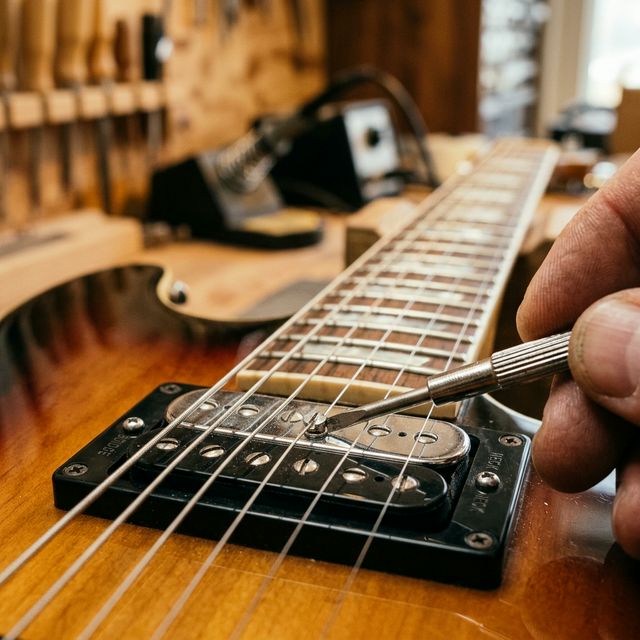
- Pickups: ProBucker-2 (neck) and ProBucker-3 (bridge) humbuckers
- Electronics: CTS potentiometers, Mallory tone capacitors, push/pull controls
- Hardware: LockTone ABR-style bridge and stopbar, Grover Rotomatic 18:1 tuners
The construction is the real deal in the ways that matter most for tone. The Les Paul design has always leaned on the combination of a dense mahogany body (for warmth and sustain) and a brighter maple cap (for snap and definition), and Epiphone replicates that pairing here rather than substituting cheaper tonewoods. The set neck — glued rather than bolted — is another core element of the Les Paul’s sustain and resonance, and it’s present here too.
The most debated spec is the Indian laurel fingerboard. Epiphone moved to laurel from rosewood on this tier, partly in response to trade restrictions on certain rosewood species. Laurel is a perfectly serviceable, stable fretboard material with a similar dark look, but some traditionalists still prefer the feel and grain of rosewood. Practically, most players won’t notice a tonal or playability difference.
Tone and the ProBucker story
The single biggest reason the Standard ’60s sounds like a Les Paul and not a Les Paul shape is the pickups. Epiphone’s ProBucker humbuckers are voiced to capture the character of Gibson’s vintage “PAF” (Patent Applied For) pickups, using unpotted coils and silver-nickel baseplates similar to the originals. The result, in the consensus of owners and reviewers, is a genuinely authentic humbucker voice: warm and round on the neck pickup, with a scooped, vocal midrange that cleans up beautifully; and a bridge pickup with real bite and compression that pushes an amp into creamy overdrive.
What sets this guitar apart from cheaper Epiphones is the electronic quality. CTS potentiometers and Mallory capacitors are the same grade of components found in far more expensive instruments, and they give the tone controls a useable taper — you can actually roll off the treble and get a darker, jazzier voice rather than an on/off mud switch.
The push/pull controls are the hidden bonus. Pulling the volume knobs splits the humbuckers to single-coil mode, which dramatically expands the tonal palette — you can get convincing Strat- and Tele-style cleans out of the same guitar. For a player who owns one electric and wants maximum versatility, that coil-split capability is a meaningful feature, not a gimmick.
Pair this guitar with the right amp and the value compounds. The Les Paul loves a tube or tube-voiced platform; our valve amp vs solid state comparison explains why the pairing matters so much for humbucker guitars.
Playability: the ’60s neck and the weight question
The ”60s” in the name refers to the neck profile. Where a ’50s Les Paul neck is a thick, rounded “baseball bat,” the ’60s SlimTaper is noticeably slimmer and faster — a shallow C-to-D shape that most modern players find immediately comfortable. Consensus among owners is that this is the more accessible of the two profiles, especially for players with smaller hands or those coming from modern shred guitars.
Fretwork on recent runs is generally reported as clean and level, with the 12” radius suiting both chord work and bending. The 24.75” scale keeps string tension a touch lower than a Fender 25.5” scale, which makes bends easier and contributes to the slinkier, warmer feel.
Then there’s the weight. This is the unavoidable Les Paul reality: a solid mahogany body with a maple cap and a set neck is a heavy instrument, and the Standard ’60s typically lands in the 8–9 lb range. Players who are used to lightweight Stratocasters or modern chambered guitars sometimes find it fatiguing over a long set. A wide, padded strap is a worthwhile investment — our how to choose a guitar strap guide walks through the comfort and security trade-offs that matter most for heavier solidbodies.
What owners and reviewers consistently praise
Synthesizing the recurring themes across verified buyer reviews and published write-ups:
- Tone authenticity. The ProBuckers are the headline. Time and again, the comment is some variation of “sounds like it costs twice the price.”
- Finish and looks. The AAA flame maple veneer under the Bourbon Burst is genuinely striking — a deep, warm amber-to-cherry gradient with figure that moves in the light. The visual quality consistently exceeds expectations at this price.
- Stable tuning. The Grover Rotomatic tuners are a real upgrade over the generic tuners on cheaper imports and hold tune reliably.
- Versatility from coil-splitting. The push/pull single-coil modes get mentioned often as a feature owners didn’t know they’d use this much.
- Value for money. The overall consensus is that this is one of the best price-to-quality ratios in Epiphone’s lineup.
Where it falls short (the honest gripes)
No guitar is perfect, and the recurring complaints are worth stating plainly:
- Weight and balance. As above — it’s heavy, and some units are neck-heavy when worn on a strap.
- Factory setup variance. Epiphone’s quality control has improved markedly, but buyers still report occasional high action, sharp fret ends, or a nut cut a bit too high. A professional setup — and possibly some nut work — is a smart first move. If you notice fret buzz or choking notes after adjusting your action, our electric guitar buzzing and fret-buzz fix guide walks through diagnosis.
- The laurel fretboard. A subjective complaint, but rosewood loyalists do call it out.
- No case included. It ships with a gig bag or no case at all depending on the retailer; a proper hardshell case is an extra purchase, and a good guitar stand is worth adding for safe storage.
- Pickup height and electronics. A minority of owners swapped pickups or pots, but most felt the stock electronics were good enough to leave alone.
How it compares to the alternatives
The obvious comparison is to a Gibson USA Les Paul Standard ’60s. The Gibson is built in Nashville with a nitrocellulose finish, a long-tenon neck joint, and BurstBucker pickups, and it costs several times more. Is the Gibson “better”? Objectively, yes — in materials, finish, and resale value. Is it several times better in sound and playability to a typical player? Almost certainly not. This is the core value question we explore in are expensive guitars worth it? — and the Standard ’60s is the textbook case for “the import gets you most of the way there for a fraction of the cost.”
Within Epiphone’s own range, the Standard ’60s sits above the entry-level Studio and below the “Inspired by Gibson Custom” models. It’s the sweet spot: enough authentic spec (CTS pots, ProBuckers, Grover tuners, flamed top) to feel like a “real” Les Paul, without climbing into four-figure territory.
Compared to other brands’ takes on the classic-humbucker-solidbody formula, the Standard ’60s wins on heritage feel and finish at this price. It’s the reference point other import Les Pauls are measured against.
The verdict
The Epiphone Les Paul Standard ’60s in Bourbon Burst earns its reputation. It delivers the look, the feel, and — crucially — the sound of a classic Les Paul at a price that makes it accessible to working musicians and serious hobbyists alike. The ProBucker pickups and quality electronics are what separate it from lesser imitations, and the ’60s SlimTaper neck makes it friendly to a wide range of hands.
Its weaknesses are the inherited weaknesses of the design: it’s heavy, and it benefits from a good setup. Neither is a dealbreaker, and both are well-understood trade-offs that come with the Les Paul territory.
If you want a single, do-it-all humbucker guitar that you can gig, record, and grow into for years — and you’d rather spend Gibson money on an amp and pedals instead — the Standard ’60s is about as good as it gets in its price class.
Bolt-on Fender-style alternatives and setup notes live in the Fender Player Stratocaster review, Strat vs Tele, and how to set up a guitar. Beginner budgets should start at best beginner electric guitars or the guitars hub.
Buying notes (what to check before you click)
What to verify on the listing and after unboxing — not a fake lab score:
- Confirm Les Paul Standard ’60s, not a Studio, Tribute, or Inspired-by-Gibson Custom SKU. Finish names change; the SlimTaper neck and ProBucker pair are the model.
- Plan a setup. High nut slots and sharp fret ends are the common QC notes. If the action buzzes after you lower it, use the fret-buzz fix guide.
- Weigh the shipping box or ask the seller. 8–9 lb is normal; if you already hate heavy Strats, this is not the lighter option.
- It often ships without a hardshell case. Budget a strap that can carry the weight and a stand.
- Amp pairing matters more than another pickup swap. Tube vs solid-state context: tube amp vs solid state.
Check the current price of the Epiphone Les Paul Standard ’60s on Amazon →
Quick Verdict
Rating: 4.4 / 5
Earns its keep as the working-musician Les Paul: the appointments read 1960, the price reads practical. Heavy weight and a needed setup are the honest cons.
Frequently asked questions
Is the Epiphone Les Paul Standard ’60s good for beginners? It’s more guitar than most absolute beginners need, and its weight and shorter scale can take adjustment. But a committed beginner who is sure they want to stick with electric will not outgrow it quickly, which can make it a smarter long-term buy than a cheap starter guitar.
What’s the difference between the Standard ’50s and Standard ’60s? The main difference is the neck profile: the ’50s has a thicker, rounder neck, while the ’60s has the slimmer SlimTaper profile. Tonally and spec-wise they’re close siblings; most modern players prefer the ’60s neck.
Do I need to change the pickups? Most owners and reviewers say no — the stock ProBuckers are a genuine highlight. Pickup swaps are a matter of personal taste rather than necessity.
Is it as good as a Gibson? Not quite, in objective materials and finish terms — but it captures the majority of the experience for a fraction of the cost, which is exactly the value proposition that made the Epiphone Les Paul famous.
What finish should I get? That’s purely aesthetic. Bourbon Burst is the warm, vintage-leaning option; others like Iced Tea, Vintage Sunburst, and Inverness Green are all the same guitar underneath. Choose the one that makes you want to pick it up and play.

Music Gear Specialist Review Desk
Research-based reviewsResearch-based reviews · Manufacturer specs · Verified owner feedback
We review guitars, amps, pedals, and recording gear the honest way: spec sheets, published measurements, and the collected experience of working musicians and verified owners.