How to Tune a Guitar: Every Method Explained
Learn 5 guitar tuning methods, clip-on, app, pedal, by ear, and harmonics, with step-by-step instructions for standard and alternate tunings.
Music Gear Specialist Review Desk
Gear Research & Analysis
ℹ️ Affiliate Disclosure: Music Gear Specialist earns from qualifying purchases through Amazon and other partner links. This doesn't affect our recommendations—we only suggest gear we'd use ourselves.
An out-of-tune guitar is the single fastest way to make yourself sound terrible, even if your technique is flawless. Every chord rings sour, every riff sounds wrong, and your ear starts doubting itself. The good news: tuning takes less than 30 seconds once you know how.
According to Fender’s 2024 Guitar Usage Report, 72% of beginner guitarists cite tuning problems as their number one frustration in the first month of playing. But it doesn’t have to be. Whether you use a $40 clip-on, a free phone app, or nothing but your ears, this guide covers every method.
TL;DR: Use a free app like GuitarTuna or a clip-on tuner like the Snark SN-5X ($15). Tune to standard E-A-D-G-B-E (low to high). Tune every time you play. New strings need extra stretching and re-tuning for the first 24-48 hours.
Standard Guitar Tuning: The Foundation
Standard tuning assigns one note to each of the guitar’s six open strings:
| String | Note | Frequency | Mnemonic |
|---|---|---|---|
| 6th (thickest) | E | 82.4 Hz | Eddie |
| 5th | A | 110 Hz | Ate |
| 4th | D | 146.8 Hz | Dynamite |
| 3rd | G | 196 Hz | Good |
| 2nd | B | 246.9 Hz | Bye |
| 1st (thinnest) | E | 329.6 Hz | Eddie |
This tuning, E-A-D-G-B-E, has been the standard for over 200 years. The vast majority of songs, lessons, chord charts, and tabs assume you’re in standard tuning unless stated otherwise.
Our tip: Always tune from below the note UP to pitch, never down to it. If you overshoot, tune the string down below the target note and come back up. Tuning upward creates tension that holds; tuning downward can leave slack that causes the string to slip flat within minutes.
Method 1: Using a Clip-On Tuner
Clip-on tuners are the most popular method for good reason, they’re fast, accurate in noisy environments, and work on both acoustic and electric guitars.
How It Works
A clip-on tuner attaches to your headstock and detects pitch through vibration (not sound). This means it works perfectly at loud rehearsals, noisy gigs, or while someone in the next room is running a blender.
Step-by-Step
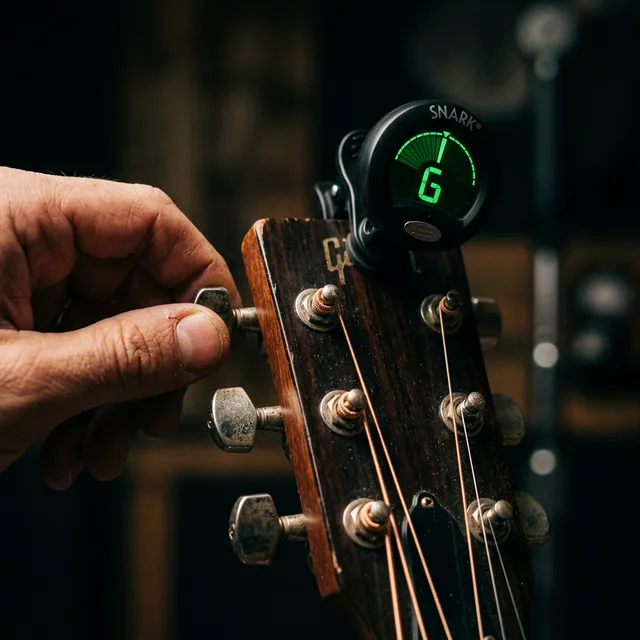
- Clip the tuner onto your guitar’s headstock, it can go on either side
- Turn it on and set it to chromatic mode (or guitar mode if available)
- Pluck the 6th string (thickest, closest to your face), one clear, firm pluck
- Read the display, it will show the detected note and whether you’re sharp (♯/too high) or flat (♭/too low)
- Turn the tuning peg until the display shows the target note centered with a green indicator
- Repeat for each string from 6th to 1st: E → A → D → G → B → E
Recommended Clip-On Tuners
- TC Electronic PolyTune Clip ($40), Best overall. Strum all 6 strings to see which are out of tune simultaneously
- Snark SN-5X ($15), Best budget. Color display goes green when in tune
- D’Addario NS Micro ($15), Nearly invisible on your headstock, perfect for gigging
Method 2: Using a Tuner App (Free)
In 2026, free tuner apps are genuinely excellent. Modern smartphone microphones detect pitch within 1-2 cents, more accurately than most human ears can distinguish.
Best Free Tuner Apps
| App | Platform | Auto-Detect | Extras |
|---|---|---|---|
| GuitarTuna | iOS, Android | Yes | Metronome, chord library |
| Fender Tune | iOS, Android | Yes | Ear training |
| Guitar Tuner (by Pitched) | iOS, Android | Yes | Minimal, fast |
Step-by-Step
- Open the app and grant microphone access
- Place your phone near your guitar, within 1-2 feet
- Ensure a quiet environment, apps use the mic, so background noise can confuse them
- Pluck one string at a time with a clear, sustained note
- Watch the indicator, the app shows whether you’re sharp or flat
- Tune the peg until the indicator centers on the target note
Our finding: The biggest mistake beginners make with tuner apps is plucking too softly. A weak pluck produces harmonics and overtones that confuse the microphone. Give each string a firm, confident pluck directly over the sound hole (acoustic) or near the middle pickup (electric).
Method 3: Using a Pedal Tuner
Pedal tuners sit on your pedalboard and serve two purposes: precision tuning plus a mute switch that silences your signal while you tune. Every gigging guitarist needs one.
Why Pedal Tuners Are Different
- Accuracy: ±0.1 cent (pedal) vs ±0.5-1 cent (clip-on) vs ±1-2 cent (app)
- Muting: Engage the tuner and your signal goes silent, the audience hears nothing while you tune
- Durability: Built to survive being stood on thousands of times
- Signal chain: Plugs directly into your signal path via 1/4-inch cables
Top Picks
- Boss TU-3 ($100), The industry standard. On 90% of professional pedalboards
- TC Electronic PolyTune 3 ($100), Polyphonic plus ±0.02 cent strobe mode
Pedal tuners are overkill for bedroom practice, but essential for live performance.
Method 4: Tuning by Ear (5th Fret Method)
The 5th fret method lets you tune your guitar to itself using just one reference pitch. It’s the method guitarists used for decades before electronic tuners existed.
How It Works
Each string pressed at the 5th fret produces the same note as the next open string below it, with one exception (the B string).
Step-by-Step
- Get a reference E, from a piano, tuning fork (E 82.4 Hz), or another in-tune guitar
- Tune the 6th string (low E) to that reference
- Press 6th string, 5th fret, it should match the open 5th string (A). Adjust the 5th string to match
- Press 5th string, 5th fret, match it to the open 4th string (D)
- Press 4th string, 5th fret, match it to the open 3rd string (G)
- Press 3rd string, 4th fret ⚠️, this is the exception! Use the 4th fret, not the 5th, to match the open 2nd string (B)
- Press 2nd string, 5th fret, match it to the open 1st string (high E)
⚠️ Critical: The G-to-B transition uses the 4th fret, not the 5th. This trips up every beginner. The B string breaks the pattern because of how guitars are tuned in 4ths with one 3rd interval.
When to Use This Method
The 5th fret method is a fantastic skill to develop, it trains your ear and means you’re never stranded without a tuner. However, small errors compound as you tune each string to the previous one. Use an electronic tuner for precision; use this method to develop your ear and as a backup.
Method 5: Tuning with Harmonics
Natural harmonics provide the most precise form of ear-tuning because harmonics produce pure, clear tones without the overtone complexity of fretted notes.
How to Play a Harmonic
Lightly touch the string directly above the fretwire (don’t press down) and pluck. Immediately lift your finger. A clear, bell-like tone should ring out.
The Pattern
- 6th string, 5th fret harmonic = 5th string, 7th fret harmonic (both produce A)
- 5th string, 5th fret harmonic = 4th string, 7th fret harmonic (both produce D)
- 4th string, 5th fret harmonic = 3rd string, 7th fret harmonic (both produce G)
- 2nd string, 5th fret harmonic = 1st string, 7th fret harmonic (both produce E)
When two harmonics are close but not perfectly matched, you’ll hear a wavering “beat” pattern. The beats slow down as you get closer to being in tune and disappear completely when the pitches match exactly.
Our finding: Harmonic tuning is the most satisfying method once you develop the ear for it. The moment those beats disappear and two harmonics lock into perfect unison is incredibly rewarding. But it takes practice, start with a tuner to verify your harmonic tuning until you’re consistently accurate.
Common Alternate Tunings
While standard tuning covers most playing situations, alternate tunings open up entirely new sonic possibilities.
| Tuning | Strings (low→high) | Used By | Best For |
|---|---|---|---|
| Drop D | D-A-D-G-B-E | Foo Fighters, RATM | Heavy rock, power chords |
| Open G | D-G-D-G-B-D | Keith Richards, Joni Mitchell | Slide guitar, folk |
| Open D | D-A-D-F#-A-D | Bob Dylan, Elmore James | Slide blues |
| DADGAD | D-A-D-G-A-D | Led Zeppelin, Celtic | Folk, fingerstyle |
| Half-Step Down | Eb-Ab-Db-Gb-Bb-Eb | SRV, Hendrix, GN’R | Slightly heavier, easier bending |
Drop D is the most common alternate tuning, simply lower your 6th string one whole step from E to D. Most tuners indicate “D” clearly.
Troubleshooting: Why Won’t My Guitar Stay in Tune?
If your guitar keeps going out of tune, work through these common causes:
New Strings
New strings stretch significantly over the first 24-48 hours. Stretch them when you install them: pull each string gently away from the fretboard at multiple points, retune, and repeat 3-4 times until the string holds pitch. This process takes 5 minutes but saves hours of frustrating re-tuning.
Temperature and Humidity
Moving a guitar from a cold car (50°F) to a warm room (72°F) can push it sharp by 10-20 cents. Let the guitar acclimate for 15-20 minutes before tuning seriously.
Worn Nut Slots
If strings make a ping sound when you tune, especially the G and B, the nut slots may be too tight. A small amount of pencil graphite rubbed in the slot often fixes this for free. If it persists, a guitar tech can file the slots properly for $20-$30.
Old Tuning Machines
Budget guitar tuning pegs can develop gear slippage over time. If a tuning peg feels loose or won’t hold position, replacement sets run $20-$50 and are a straightforward DIY installation.
Tremolo Bridge Issues (Strat-Style)
Tremolo bridges rely on spring tension balancing string tension. If your Strat won’t stay in tune after using the whammy bar, the springs likely need adjustment. This is best handled during a professional setup ($50-$75).
Keep Reading
- Best Guitar Tuners: Clip-On, Pedal, and App Compared, our detailed tuner reviews
- How to Set Up Your Guitar Like a Pro, complete setup guide
- How to Change Guitar Strings, step-by-step string replacement
- Basic Guitar Chords Every Beginner Needs, start playing songs
- Best Acoustic Guitars for Beginners, our top picks

Music Gear Specialist Review Desk
Research-based reviewsResearch-based reviews · Manufacturer specs · Verified owner feedback
We review guitars, amps, pedals, and recording gear the honest way: spec sheets, published measurements, and the collected experience of working musicians and verified owners.