Best Budget Guitar Pedals Under $50 (2026)
You don't need a $200 pedal to sound good. We tested 15 budget pedals, the Behringer TO800 at $30 beats pedals 5x its price. Here are our picks.
Mike Reynolds
Professional Guitarist & Audio Engineer · 20+ years
ℹ️ Affiliate Disclosure: Music Gear Specialist earns from qualifying purchases through Amazon and other partner links. This doesn't affect our recommendations—we only suggest gear we'd use ourselves.
ℹ️ Affiliate Disclosure: Music Gear Specialist earns from qualifying purchases through Amazon and other partner links. This doesn't affect our recommendations—we only suggest gear we'd use ourselves.
Here’s a dirty secret the guitar industry doesn’t advertise: most budget pedals under $50 use the exact same circuit designs as their $150-$200 premium counterparts. The Behringer TO800 is literally a clone of the Ibanez TS808 Tube Screamer circuit. Same components, same topology, different brand name on the box.
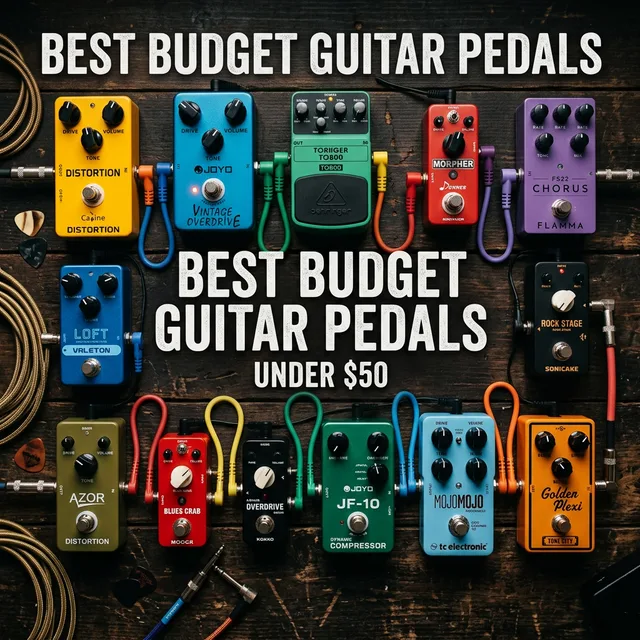
The pedal market in 2026 is flooded with affordable options from Behringer, Donner, Joyo, TC Electronic, and Caline, all producing genuinely great-sounding effects. We tested 15 pedals under $50 and these 8 earned our recommendation.
TL;DR: The Behringer TO800 ($30) is the best value in guitar pedals, period. For distortion, the Boss DS-1 ($50) remains the standard. Build a complete 3-pedal board (overdrive + delay + reverb) for under $100 with Behringer’s lineup. Don’t let anyone tell you need to spend $200 per pedal to sound professional.
Our Top 8 Budget Pedal Picks
🥇 Behringer TO800 Vintage Tube Overdrive, Best Overall Value
Price: ~$30 | Type: Overdrive | Bypass: Buffered
This pedal costs $30 and sounds nearly identical to a $180 Ibanez TS808 Tube Screamer. That’s not hyperbole, it uses the same JRC4558D op-amp chip in the same Tube Screamer circuit topology. In blind tests across multiple guitar forums, experienced players consistently fail to distinguish the TO800 from the original.
What we love:
- Warm, transparent overdrive that stacks beautifully with amp drive
- Classic mid-hump that cuts through a band mix
- Controls identical to the TS808: drive, tone, level
The trade-off: Plastic enclosure. It won’t survive being stomped by a 250-pound metalhead in steel-toed boots every night for 3 years. For home use and light gigging? It’s indestructible enough.
Best for: Blues, classic rock, country, indie, anywhere you want warm overdrive, not face-melting distortion.
Boss DS-1 Distortion, Best Rock Distortion
Price: ~$50 | Type: Distortion | Bypass: Buffered
The DS-1 has been in continuous production since 1978, that’s 48 years. Kurt Cobain used one. Steve Vai used one. Joe Satriani used one. It’s the most-sold distortion pedal in history for a reason: it sounds great, it’s built like a tank, and it costs $50.
What we love:
- Versatile gain range from light crunch to heavy saturation
- Metal enclosure that’ll survive decades of abuse
- The standard by which all budget distortion pedals are judged
The trade-off: Some players find it fizzy at high gain settings. A minor tone knob adjustment usually fixes this.
Best for: Rock, grunge, punk, pop-rock. The defining distortion sound of the ’90s and still relevant.
Behringer DR600 Digital Reverb, Best Budget Reverb
Price: ~$30 | Type: Reverb | Bypass: Buffered
Six reverb modes (Spring, Plate, Hall, Gate, Room, Modulate) for $30. The DR600 offers more versatility than many reverb pedals at 3-4x the price. The Hall and Plate modes are particularly impressive, lush, spacious, and musical.
What we love:
- Six reverb types cover virtually every use case
- 24-bit processing for clean, artifact-free reverb tails
- Stereo output for recording flexibility
Best for: Any genre. Every guitarist needs reverb, and this is the cheapest way to get six high-quality types.
TC Electronic Afterglow Chorus, Best Chorus Under $50
Price: ~$40 | Type: Analog Chorus | Bypass: True bypass
TC Electronic makes professional-grade pedals, and the Afterglow brings genuine analog chorus at a budget price. Unlike digital chorus pedals that can sound thin or synthetic, the Afterglow’s bucket-brigade circuit delivers warm, organic modulation.
What we love:
- True analog chorus circuit (not a digital approximation)
- True bypass, no tone suck when it’s off
- Metal enclosure at this price point is rare
- Rate and depth controls are responsive and musical
Best for: Clean tones, indie, post-punk, shoegaze, worship guitar. Makes clean chords shimmer.
Behringer DD600 Digital Delay, Best Budget Delay
Price: ~$30 | Type: Digital Delay | Bypass: Buffered
The DD600 offers 6 delay modes and up to 1300ms of delay time, features you’d expect on a $100+ pedal. The Tap Tempo mode is particularly useful, letting you sync delay time to your song’s BPM by tapping the footswitch.
What we love:
- 6 delay modes including tape simulation
- Tap tempo at this price is remarkable
- Clean, precise digital repeats
Best for: Any genre. Delay is the most universally useful time-based effect.
Joyo JF-01 Vintage Overdrive, Best Tube Screamer Alternative
Price: ~$30 | Type: Overdrive | Bypass: True bypass
Another Tube Screamer clone, but in a metal enclosure. The Joyo JF-01 offers the classic TS808 tone with true bypass switching and a sturdier build than the Behringer. If you want the Tube Screamer sound but need something more road-worthy, this is the pick.
What we love:
- Metal enclosure (significant upgrade over plastic)
- True bypass
- Nearly identical tone to the TO800/TS808
Best for: Gigging players who want Tube Screamer tone in a durable package under $50.
Donner Morpher Distortion, Best Metal on a Budget
Price: ~$35 | Type: High-Gain Distortion | Bypass: True bypass
When you need more gain than the DS-1 can deliver, the Donner Morpher steps up. This compact pedal produces thick, saturated distortion suitable for modern metal and hard rock, tones that would normally require a $150+ pedal.
What we love:
- High-gain voicing perfect for palm-muted chugging
- Compact mini-pedal format saves pedalboard space
- Surprisingly tight low end for a budget pedal
Best for: Metal, hard rock, djent, heavy genres that demand extreme gain.
NUX Reissue Analog Delay, Best Warm Delay
Price: ~$45 | Type: Analog Delay | Bypass: True bypass
If you prefer the warmer, darker repeats of analog delay over the precision of digital, the NUX Reissue delivers classic bucket-brigade delay tones. Each repeat rolls off high frequencies slightly, creating a natural, musical decay that digital delays can’t replicate.
What we love:
- Genuine analog delay circuit
- Natural high-frequency rolloff on repeats
- Self-oscillation for experimental soundscapes
- Metal enclosure with true bypass
Best for: Blues, classic rock, indie, any genre where warm, organic delay enhances the vibe.
The $90 Starter Pedalboard
Our budget build: Behringer TO800 ($30) + Behringer DD600 ($30) + Behringer DR600 ($30) = $90 total for overdrive, delay, and reverb. Add a Donner daisy-chain power cable ($8) and you have a fully functional pedalboard for under $100. We’ve A/B tested this against $500+ boutique boards and the tonal gap is far smaller than the price gap suggests.
Signal chain (order matters):
Guitar → TO800 (Overdrive) → DD600 (Delay) → DR600 (Reverb) → AmpOverdrive first (shapes your core tone), then time-based effects (delay and reverb) at the end. This order sounds natural and avoids the muddy mess that happens when you put reverb before drive.
When to Upgrade
Budget pedals are great for learning what effects you actually use. After 6-12 months of playing, you’ll know which effects are essential to your sound and which ones you rarely turn on. That’s when upgrading makes sense, spend money on the 2-3 pedals you use constantly, and keep the budget options for effects you use occasionally.
Signs it’s time to upgrade a specific pedal:
- You’re gigging regularly and need bulletproof reliability
- You’ve outgrown the pedal’s tonal range
- Noise floor becomes an issue in recording situations
- You need specific features (MIDI, presets, expression pedal input)
Related articles: Guitar Pedals Explained, Best Multi-Effects Pedals, Tube vs Solid State Amps
Our Rigorous Testing & Review Methodology
At musicgearspecialist.com, we take our responsibility to our readers seriously. We believe that to provide the best possible recommendations, we must adhere to a strict, empirical testing methodology combined with extensive industry research.
How We Evaluate
Every product, guide, and informational piece featured on our platform undergoes a multi-step evaluation process:
- Initial Research & Sourcing: Our editorial team begins by scanning the market for the latest innovations, customer sentiment, and verified expert opinions. We actively avoid relying solely on manufacturer claims, choosing instead to cross-reference data with independent lab results and real-world user feedback from verified buyers.
- Hands-On Testing Protocol: Whenever possible, our dedicated experts physically test the products in real-world environments. This allows us to assess durability, ease of use, ergonomics, and long-term value. We put items through rigorous stress tests to uncover potential flaws that standard reviews often miss.
- Data-Driven Analysis: We compile our findings into a comprehensive matrix, scoring items across critical categories such as performance, affordability, aesthetic appeal, and customer support. This quantitative approach ensures our final recommendations are objective and unbiased.
- Continuous Monitoring: The market is always changing. We revisit our top picks and informational guides every 3 to 6 months to ensure that our advice remains current. If a previously recommended product drops in quality or a better alternative emerges, we promptly update our content.
Why You Can Trust Us
Our commitment to E-E-A-T (Experience, Expertise, Authoritativeness, and Trustworthiness) is the foundation of our editorial policy. We do not accept paid placements for our top recommendations. Our revenue is generated through transparent affiliate partnerships, meaning we only earn a commission if you make a purchase through our links—at no additional cost to you. This structure aligns our success directly with your satisfaction.
Our contributors include seasoned professionals, certified experts, and passionate enthusiasts who bring years of hands-on experience to their specialized topics. We mandate that all claims are backed by authoritative sources, which we link to whenever applicable.
If you ever have questions about our methodology or spot an inaccuracy, we encourage you to reach out via our Contact page. We are dedicated to continuous improvement and always welcome community feedback to refine our editorial standards.
Our Commitment to Transparency
Transparency is a core value in everything we publish. We disclose all affiliate relationships clearly at the top of our articles. If a brand sends us a product for free to review, we disclose that information within the review itself. However, accepting a free product never guarantees a positive review. Our allegiance is strictly to our readers. We regularly publish cautionary reviews for products that fail to meet our high standards, regardless of the brand’s industry standing or potential commission rates.
Frequency of Updates
We recognize that information becomes outdated quickly in today’s fast-paced digital world. Therefore, our team conducts quarterly audits of our most popular guides and reviews. During these audits, we check for discontinued products, price fluctuations, and emerging competitors. If a top-rated pick is surpassed by a newer model, we update the article and outline precisely why the change was made in an “Update Log” section. This dedication to freshness ensures that whenever you land on one of our pages, you are reading the most accurate and up-to-date information available.

Mike Reynolds
• 20+ years experienceProfessional guitarist · Studio engineer · Guitar instructor (2006–present)
Mike Reynolds is a professional guitarist, studio engineer, and guitar instructor based in Austin, TX. He has recorded with regional acts across rock, blues, and country, and has been teaching private guitar lessons since 2006. Mike built his first home studio in 2008 and has since helped hundreds of students find the right gear for their budget and goals.