Best Pedalboards and Power Supplies
Pedalboard listing checks: board size vs pedal count, isolated vs daisy power, Dual Lock vs Velcro, and whether the case is included.
Music Gear Specialist Review Desk
Gear Research & Analysis
ℹ️ Affiliate Disclosure: Music Gear Specialist earns from qualifying purchases through Amazon and other partner links. This doesn't affect our recommendations—we only suggest gear we'd use ourselves.
ℹ️ Affiliate Disclosure: Music Gear Specialist earns from qualifying purchases through Amazon and other partner links. This doesn't affect our recommendations—we only suggest gear we'd use ourselves.
You’ve bought three pedals, and now every practice session starts with 10 minutes of plugging and unplugging cables, reorganizing your floor, and wondering why there’s a mysterious hum in your signal. The solution: a pedalboard and isolated power supply that turns your pedal collection into a single, grab-and-go instrument.
TL;DR: Pedaltrain Classic Jr ($70) + Voodoo Lab Pedal Power 2+ ($180) is the gold-standard combo. For budget, the Donner DB-3 pedalboard ($30) + Donner DP-1 power supply ($40) gets the job done for $70 total.
Professional Pedalboard Quick Picks
A professional pedalboard is not just a bigger board. It is a complete, repeatable rig: solid mounting, isolated power, quiet cables, enough space for your real signal chain, and a case that survives rehearsals, gigs, and recording sessions.
| Player need | Best professional pedalboard direction | Why |
|---|---|---|
| Most gigging guitarists | Pedaltrain Classic Jr + Voodoo Lab PP2+ | Reliable size, proven isolated power, easy cable routing |
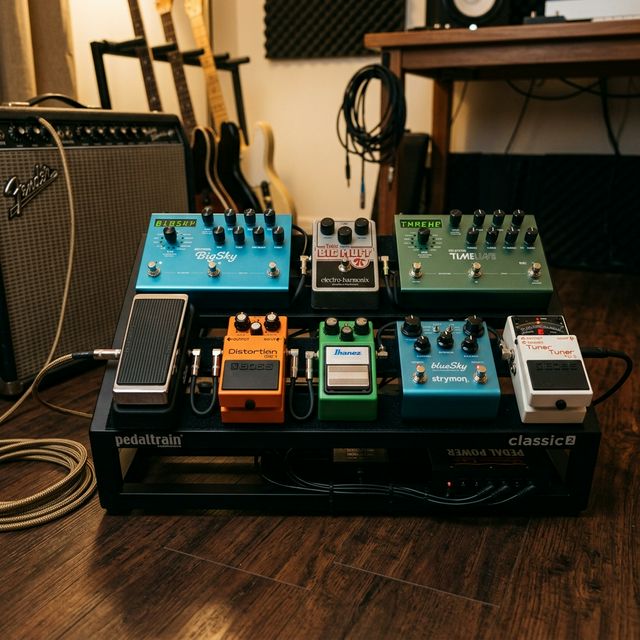
| Larger touring board | Pedaltrain Classic 2 + Strymon Zuma | More room and high-current outputs for digital pedals |
| Compact fly-date board | Pedaltrain Metro 16 + compact isolated supply | Fits essentials without wasting luggage space |
| Budget professional-style rig | Donner DB-3 + Donner DP-1 | Inexpensive path to mounted pedals and cleaner power |
| Recording-focused board | Any rigid board + isolated power + short patch cables | Lower noise matters more than board brand |
For most players building a professional pedalboard, the safest starting point is a medium Pedaltrain-style board, isolated power, low-profile patch cables, and one open slot for a future tuner, boost, or delay. If you are still deciding what should go on the board, start with our guitar pedals explained guide and our pedalboard signal chain order walkthrough.
Pedalboard Picks
Pedaltrain Classic Jr, Best Pedalboard
Price: ~$70 (with soft case) | Size: 18” x 12.5” | Pedal capacity: 5-8
Pedaltrain invented the aluminum rail pedalboard design that 90% of professionals now use. The Classic Jr fits 5-8 standard-size pedals, has an angled surface for easy access, and the space underneath conceals your power supply and cables. Includes a padded carry bag.
Best for: Most guitarists with 4-8 pedals. The default choice.
Pedaltrain Classic Jr Pedalboard with Soft Case
Pedaltrain Metro 16, Best Compact
Price: ~$50 (with soft case) | Size: 16” x 8” | Pedal capacity: 3-5
For mini pedalboards with just essentials (tuner, overdrive, delay), the Metro 16 is the perfect size. Small enough for a gig bag, big enough for the core effects.
Best for: Minimalist setups, fly-date rigs, players with 3-4 pedals.
Pedaltrain Metro 16 Pedalboard with Soft Case
Donner DB-3, Best Budget
Price: ~$30 | Size: 16.5” x 9” | Pedal capacity: 5-7
The Donner DB-3 is an Aluminum alloy board with carry bag for just $30. It’s not as refined as Pedaltrain, the rails are slightly narrower and the bag is thinner, but it holds pedals, accepts Velcro, and fits a power supply underneath.
Best for: Budget builds, first pedalboard, experimental setups.
Donner DB-3 Aluminum Pedalboard with Bag
Power Supply Picks
Voodoo Lab Pedal Power 2+, Best Overall Power
Price: ~$180 | Outputs: 8 isolated | Voltage: 9V/12V
The PP2+ has been the professional standard for isolated power since the early 2000s. Eight fully isolated outputs, ultra-low noise, switchable 9V/12V on two outputs, and bullet-proof reliability. It fits under any Pedaltrain board.
Best for: Professionals, noise-sensitive setups, reliable touring power.
Voodoo Lab Pedal Power 2+ Isolated Power Supply
Strymon Zuma, Best Premium Power
Price: ~$250 | Outputs: 9 isolated | Voltage: 9V (selectable to 12V/18V)
The Zuma offers 9 fully isolated outputs with 500mA per output, enough for power-hungry digital pedals that choke on lesser supplies. Rack-mountable, dead silent, and expandable with Strymon OJai modules.
Best for: Large boards, power-hungry digital pedals, premium builds.
Strymon Zuma R300 Isolated Power Supply
Donner DP-1, Best Budget Power
Price: ~$40 | Outputs: 10 (8 isolated + 2 daisy) | Voltage: 9V/12V/18V
At $40, the DP-1 offers 8 isolated outputs plus voltage flexibility. It’s noisier than the Voodoo Lab under extreme conditions, but for home use and most live situations, it’s impressively clean.
Best for: Budget boards, home practice, first power supply.
Donner DP-1 Guitar Power Supply (10 Isolated Outputs)
What to Look For in a Pedalboard
A pedalboard is more than a carrying tray, it’s a signal chain organizer, power distribution center, and tone-preservation system. The right board keeps your rig reliable on stage and inspires you to practice at home.
Size and pedal count: Map out the pedals you actually own (or plan to buy in the next year) before choosing a board. The most common mistake is buying a board that’s just slightly too small. As a rule: buy the next size up from what you think you need. Pedals grow in number, not shrink.
Included power supply vs none: Boards like the Pedaltrain Metro bundled with a Volto power supply cost more upfront but save you from buying a separate unit. Boards sold without power supplies (most Pedaltrain boards) give you flexibility to choose your own power, critical if you run digital pedals (multi-effects, modelers) that need isolated, high-current outlets that budget power bricks can’t provide.
Isolated power supplies: The single most impactful upgrade for most guitarists with hum issues is switching to an isolated power supply. Non-isolated power supplies (daisy chains) share ground across all outputs, any digital pedal or cheap pedal on the chain can introduce noise. Isolated supplies give each pedal its own electrically separate output, eliminating ground loops completely. The Voodoo Lab Pedal Power 2+ is the gold standard for a reason.
Hard case vs soft bag: Pedaltrain boards come with tour-grade hardshell cases; Donner boards ship bare. If you’re gigging, the case isn’t optional, pedals shift, cables pull loose, and power supplies crack from impacts. Factor case cost into any “budget” board comparison.
Cable routing: Quality boards have channels, rails, or cable management slots beneath the playing surface. Running cables underneath keeps your board tidy and protects them from foot traffic. Boards without this feature look chaotic quickly and make troubleshooting a nightmare mid-gig.
Pedalboard Setup Essentials
| Item | Budget | Mid-Range | Premium |
|---|---|---|---|
| Board | Donner DB-3 ($30) | Pedaltrain Classic Jr ($70) | Pedaltrain Classic 2 ($130) |
| Power | Donner DP-1 ($40) | Voodoo Lab PP2+ ($180) | Strymon Zuma ($250) |
| Cables | Hosa patch cables ($15) | EBS patch cables ($40) | Lava Cable solderless ($60) |
| Velcro | Generic ($5) | 3M Dual Lock ($15) | Pedaltrain Velcro ($10) |
| Total | ~$90 | ~$305 | ~$450 |
For deeper power planning, read our guitar pedal power supply guide. It covers voltage, polarity, current draw, isolated outputs, and daisy-chain risks before you plug anything expensive into the wrong supply. Fastener choice — Dual Lock vs hook-and-loop — is a separate decision; see Dual Lock vs Velcro for pedalboards.
Buying notes (what to check before you click)
Listing checks the product title usually omits:
- Count pedals and the power brick. A Classic Jr that looks empty in the photo may not fit a Voodoo Lab Pedal Power 2+ underneath.
- Isolated vs daisy is not a vibe choice. If the listing is a wall-wart splitter, read guitar pedal power supply compatibility and can you use any power supply on a pedalboard before you click.
- Fastener is sold separately on most Donner boards. Dual Lock vs hook-and-loop is Dual Lock vs Velcro for pedalboards.
- Hum after you fill the board is usually power or order, not the rails. See how to reduce pedalboard noise.
- Confirm whether the case is included. Pedaltrain often is; budget boards often are not. Next reads: pedals hub · signal chain order.
FAQ
What makes a professional pedalboard?
A professional pedalboard uses a rigid board, secure pedal mounting, isolated power, low-profile patch cables, clean cable routing, and enough space for the current rig plus one or two future pedals. For most gigging players, a Pedaltrain Classic Jr or Classic 2 with a Voodoo Lab or Strymon isolated power supply is the safest starting point.
Is isolated power worth it for a professional pedalboard?
Yes. Isolated power is one of the biggest differences between a casual board and a professional pedalboard. It reduces hum, keeps digital pedals from polluting analog pedals, and makes the rig more reliable for recording and live work.
Keep Reading
- Dual Lock vs Velcro for Pedalboards, which fastener to use on the board
- Guitar Pedals Explained, every effect type covered
- Best Overdrive Pedals, the pedals that go on your board
- Best Budget Guitar Pedals, build a board for under $200
- Best Guitar Cables, the connections that matter

Music Gear Specialist Review Desk
Research-based reviewsResearch-based reviews · Manufacturer specs · Verified owner feedback
We review guitars, amps, pedals, and recording gear the honest way: spec sheets, published measurements, and the collected experience of working musicians and verified owners.